Tuesday, May 14, 2019

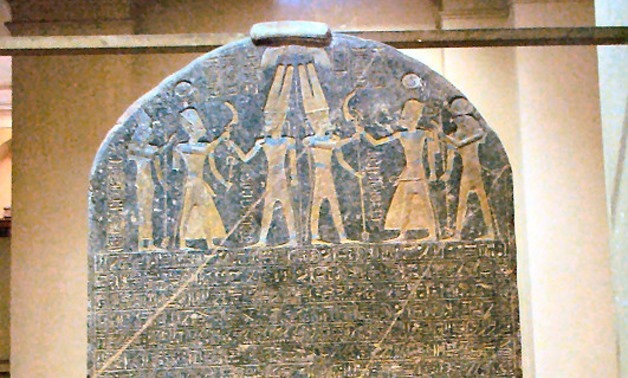
Seti Merenptah’s 'Israel' Stele


Merneptah Stele - Webscribe, Wikimedia Commons

by
 
Damien F. Mackey


Bimson thought (at least as late as 1980) that Merenptah’s Stele had pre-dated
the fall of Samaria by about a decade, to c. 734-733 BC; it being a reference rather
to the earlier Assyrian deportations of Israel by Tiglath-pileser III.


To recall what I have written previously:
 
– According to Courville, as we have seen, the stele’s inscription pertains to the Assyrian deportation of Samaria in c. 722/721 BC.
 
– Velikovsky would later look to connect it with the deportation of the Jews to Babylon after the sack of Jerusalem by Nebuchednezzar II [Ramses II and His Time, pp. 189-196]. Though Bimson has estimated Velikovsky’s date for the 5th Year of Merenptah at “no earlier than 564 BC … 23 years after the fall of Jerusalem” [‘An Eighth Century Date for Merenptah’, p. 57].
 
– Bimson thought (at least as late as 1980) that Merenptah’s Stele had pre-dated the fall of Samaria by about a decade, to c. 734-733 BC; it being a reference rather to the earlier Assyrian deportations of Israel by Tiglath-pileser III. …. [Ibid. See also ‘John Bimson replies on the “Israel Stele”,’ pp. 59-61].
 
– Rohl has in turn dated the conquests described in the stele to those effected by Seti I and Ramses II, his candidate for the biblical ‘Shishak’, himself regarding the stele as being Merenptah’s merely basking in the glory of what these, his great predecessors, had achieved before him. […. A Test of Time, ch. 7, pp. 164-171].
 
[End of quote]
 
For Drs. Velikovsky, Courville and Bimson (back then), this Egyptian Stele was supposedly commemorating one or another Assyro-Babylonian triumph – a most unlikely scenario! 
 
And Rohl, for his part, though regarding the document as being a commemoration of Egyptian victories, considered these to be triumphs pre-dating pharaoh Merenptah – victories by his predecessors, Seti I and Ramses II.  
 
Only Martin Sieff, amongst the revisionists, had envisaged this as being an Egyptian victory achieved by Merenptah himself.
 
Thus I wrote:
 
– And Sieff … related Merenptah’s victory to what he called the “time of troubles in the northern kingdom of Israel after the death of Jeroboam II”.
 
Martin Sieff’s realistic version, which is the one that I basically embraced in my postgraduate university thesis (Volume One, Chapter 11, pp. 300-305):
 
A Revised History of the Era of King Hezekiah of Judah
and its Background
 
 
was dependent upon the biblical chronology of Martin Anstey - and taken up by Philip Mauro - that the reign of Jeroboam II in Israel was followed by a 22-year period of interregnum.
 
Patrick Clarke
 
Rohl’s revised chronology, according to which Ramses II was the biblical pharaoh “Shishak” at the time of king Rehoboam of Judah (I Kings 14:25), has recently been picked up by Creationist, Patrick Clarke in his article, “The Stele of Merneptah—assessment of the final ‘Israel’ strophe and its implications for chronology”:
 
 It is clear that the Merneptah stele can be interpreted in line with the United and Divided Monarchy Periods of Israelite history. Furthermore, if it can be demonstrated that Merneptah’s father, Ramesses II, was in fact Shishak, many synchronisms previously held by both supporters of the CEC [conventional] and revisionists between the people of Israel and their neighbours collapse, and a whole new series of compelling synchronisms emerges. The reigns of Ramesses II and Merneptah are contemporaneous with the last few years of the United Monarchy and the first 75 years of the Divided Monarchy. A detailed analysis of the ‘Israel’ text indicates that far from being placed in the 1200s bc, Merneptah’s reign should be dated to 913–903 bc; a movement of three centuries. Consequently, Ramesses II would have reigned from 979–913 bc, in the Divided Monarchy Period. In my proposed revised chronology all the political, military, and economic factors detailed on the stele coincide with conditions in Israel. This was not the case three centuries earlier in the time of the Judges.
[End of quote]
 
Whilst Clarke is correct in rejecting the conventional location of the Merenptah Stele to the approximate period of “the Judges”, his chronological re-setting of Ramses II and Merenptah has, in my opinion, dire consequences for the best efforts of the revision as explored by the likes of Drs. Velikovsky and Courville, and modified and enhanced by astute minds of the “Glasgow School” (including Martin Sieff).
For, as Clarke goes on to write:
 
Once this historical re-alignment takes place, a number of synchronisms previously held to be true by some revisionists, albeit well-intentioned, are refuted. Some of these erroneous synchronisms are: Thutmose III/Shishak;31 Hatshepsut/Queen of Sheba;32 Amenhotep II/Zerah the Cushite; Israel’s King Ahab/Battle of Qarqar; Israel’s King Jehu/Shalmaneser III—the final two failed synchronisms in this list have serious implications for the less than reliable Assyrian chronology.33
[End of quote]
 
No thank you. I myself shall stick with the, now manifold, synchronisms - as worked out by revisionists - between Egypt’s 18th dynasty and the United to Early Divided kingdom periods, especially those iron-cast synchronisms with El Amarna.
 
Clarke’s most useful contribution is, in my opinion, his expertise in Egyptian Hieroglyphics, which he has correctly noted has not been a strong suit amongst revisionists: “Knowledge of the Egyptian language and syllabic orthography is essential when assessing any Egyptian text, otherwise mistakes are inevitable”. Thus Clarke writes with regard to the Stele: 
 
This reliance in Christian works on blind copying of old, outdated translations, which probably reflects the dearth of competent archeology and history specialists in the Christian community, is fraught with problems, as will be seen.
 
Knowledge of the Egyptian language and syllabic orthography is essential when assessing any Egyptian text, otherwise mistakes are inevitable. The majority of Egyptologists are in agreement regarding the entity ysry3l as Israel based on the syllabic orthography of the name and the context of the final poetic unit of the Merneptah stele. It is the chronological placement of Israel where scholars of the CEC and revisionist positions come into conflict.
[End of quote]
 
Clarke is particularly scathing about professor Joseph Davidovits, whom he calls “A secularist”, regarding the latter’s unorthodox translation of the Victory Stele (see Clarke’s section on p. 62: “A secularist attempt to deny Israel is even mentioned on the stele”).
 
A suggested solution
 
With my modification of the Nineteenth Egyptian Dynasty in its relation to Seti and the awkward Third Intermediate Period in multi-part series such as:
 
Smendes and Shoshenq I
 
beginning with:
 
 
and:
 
Seti I and Seti II Merenptah
 
beginning with:
 
 
I am now inclined to accept Rohl’s and Clarke’s opinion that the Israel Stele pertains to an early Nineteenth Dynasty ruler, such as Seti – but with my twist to this, that Seti was Merenptah.
 
See especially my article on this:
 
Seti I and Seti II Merenptah. Part Three: Seti I and II Merenptah and Merenptah


Wednesday, April 10, 2019

Some pointers towards a chronological revision


Image result for exodus-documentary-evidence

 
by
 
Damien F. Mackey


A budding revisionist wrote to me:

….
It’s a joy to find your work. About seven months ago, I became very interested in chronological revisionism, first concerning the exodus from Egypt and conquest of Canaan, but then more radical revisionism so that the Egyptian civilization (and others) might postdate the Flood (around 2274 BC in my estimation). I’ve read the work of David Rohl and Peter James, who appear to be “soft revisionists”- reworking the chronology so that the exodus and conquest make good sense, and I’m starting to read Donovan Courville right now. The difficulty is that I, as a non-expert, have virtually no way of evaluating the merits of these respective chronologies, especially where they diverge (concerning whether the Old Kingdom ought to undergo a radical revision and concerning the dates of the Amarna period on).
Do you have any recommendations as to where I should begin, and what work I should read first?
 
Thanks much ….

 
To which I replied (modified and updated now):
 
….
I can well appreciate how perplexing you must find the whole thing to be. There is the conventional system of which one ought to have a solid grasp, and then there are all of those quite different revised systems, none fully agreeing.
 
Peter James and David Rohl have been important, inasmuch as they have corrected some of the mistakes made by Dr. I. Velikovsky (who was a pioneer).
Peter James’s Centuries of Darkness is a classic, and ought to be read.
But I would agree with you that their (Rohl’s and James’s) revisions are “soft”, floating precariously as they do halfway between Velikovsky and convention.
 
Martin Sieff is, to my thinking, the pick of the revisionists writing in that quite productive period of the mid-late 70’s and the 80’s. Amongst the following one will find some classics of his:
 
  • “Velikovsky: The Score of Success”, SIS Newsletter 1, April 1975
  • “Velikovsky: The Open Minded Approach”, SIS Newsletter 2, September 1975
  • “In Defence of the Revised Chronology”, Peter James & Martin Sieff, SIS Review v1 No. 1, January 1976
  • “Diana at Ephesus”, Martin Sieff assisted by Peter James, SIS Review v1 No. 2, Spring 1976
  • “Planets in the Bible: I — The Cosmology of Job”, SIS Review v1 No. 4, Spring 1977
  • “The Two Jehorams”, SIS Review v2 No. 3, Special Issue 1977/78
  • “Velikovsky and His Heroes”, SIS Review v5 No. 4, 1984
  • “The Bible Through a King James Filter”, SIS Workshop no. 1, March 1978
  • “Book Review”, SIS Workshop no. 4, February 1979
  • “The Father of the Gods?”, SIS Workshop vol.3 No.2, October 1980
  • “Voyager: Questions and Answers”, SIS Workshop vol.3 No. 3, January 1981
  • “The Hittites in Israel”, SIS Workshop vol.4 No.1, July 1981
  • “Assyria and the End of the Late Bronze Age”, SIS Workshop vol.4 No. 2, September 1981
  • “Limited Fusion” and “Anode-Stars”, SIS Workshop vol.4 No. 3, December 1981
  • “The Emerging Revision of Ancient History: Recent Research”, Velikovskian vol. 2 No. 1, 1994
  • “The History Of The Revisionist Debate: A Personal View”, Velikovskian vol. 3 No. 4, 1997
  • “The Road to Iron: 8th and 7th Century Metallurgy and the Decline of Egyptian Power”, Catastrophism & Ancient History, Volume IV, Part 2, July 1982
  • “Scarab in the Dust: Egypt in the Time of the Twenty-First Dynasty”, Catastrophism& Ancient History, Volume VII, Part 2, July 1985
  • “The Libyans in Egypt: Resolving the Third Intermediate Period”, Catastrophism& Ancient History, Volume VIII, Part 1, January 1986
  • “Assyrians, Sodom, and Red Herrings”, Catastrophism & Ancient History, Volume X, Part 1, January 1988
  • “The Oracle of Cadmus”, Catastrophism & Ancient History, Proceedings of the Second Seminar of Catastrophism and Ancient History (Held Dec 1983)) 1985
  • “The Chaldeans of Sumer”, Aeon vol.1 No. 2, Feb 1988
  • “The Hyksos Were Not Assyrians”, Aeon vol.1 No.4, Jul 1988
  • “Remembering Velikovsky”, Aeon vol.4 No. 2, Aug 1995
     
    Dr. Courville is very good, systematic, but rather heavy going. He, too, was a pioneer and stands in need of some modifications.
    But he will generally set you on quite a good path.

    There are some anchors that I personally would insist upon, and you will find these within my articles at Academia.edu
    To summarise some to these:
     
    Bringing early Egyptian history into line with the Bible, especially using the perceptive stratigraphy of Dr. John Osgood for the period of Abram (Abraham).
    See e.g. my article:
     
    Better archaeological model for Abraham
     
     
    Also, and most importantly, the Middle Bronze I people as the Exodus Israelites:
     
    The Bible Illuminates History and Philosophy. Part Seven: Middle Bronze I Israelites


Dr. Courville has missed the compelling link between Joseph of Egypt and the genius Vizier Imhotep. See my attempt to correct this in my series:
 
Moses – may be staring revisionists right in the face
 
beginning with Part One:
 
 
Velikovsky’s thesis that the United Kingdom of Israel and Egypt’s 18th dynasty were contemporaneous, with Hatshepsut as the Queen of Sheba and Thutmose III as the biblical Shishak.
See e.g. my articles (for Hatshepsut):
 
 
and (for Thutmose III):


Dr. Velikovsky’s vitally important connections of El Amarna’s kings of Amurru with biblical kings of Syria (in Ages in Chaos, I).

Peter James’s important correcting of El Amarna’s Abdi-hiba of Urusalim (Velikovsky’s king Jehoshaphat) to Jehoshaphat’s son, Jehoram, instead. See e.g. my series on this:


and:


Another certain thing, the conventional view of Ramses II as a contemporary of Moses is hopelessly wrong. See e.g. my articles:
 
The Exodus in need of a realistic time-frame
 
 
and:
 
New Revision for Ramses II
 
 
Highly important (at least I think), too, is the synchronisation of king Sennacherib’s loss of his massive Assyrian army in Israel at the time of the heroine Judith, and narrated in the Book of Judith. See e.g. my article:


I hope that this will be of some use to you ….
 
My best regards,
Damien.


Part Two: Supplementing Part One


Dr. John Osgood appears to have nailed the archaeological period for


the oppressor king, Cushan-rishathaim of Judges 3:8.


Patriarch Abram (Abraham), archaeologically, needs to be located to the stratigraphical era of the Late Chalcolithic/Early Bronze I, and not to Middle Bronze I (MBI) - as is generally thought - where he would displace the Exodus Israelites, the true MBI people of half a millennium later.


The best fit for the “new king” of Exodus 1:8, early in the life of Moses, is, I think, pharaoh Amenemhet (Amenemes) I, the founder of the Twelfth Dynasty (Middle Kingdom, so-called). See e.g. my article:


Twelfth Dynasty oppressed Israel


And see the following articles for the archaeology of:


Eglon's Jericho


Who was Hiel? For my preferred candidate see:


Hiel's Jericho. Part Two (a): Who was this “Hiel of Bethel”?


Dr. John Osgood appears to have nailed the archaeological period for the oppressor king, Cushan Rishathaim of Judges 3:8. See his important stratigraphical article on this:


The Times of the Judges—The Archaeology:


(b) Settlement and Apostasy


Regarding Egypt, the United Kingdom of Israel’s kings, Saul, David and Solomon synchronise with the early Eighteenth Dynasty, from Ahmose I down to Thutmose III.


Regarding Mesopotamia, David and Solomon were contemporaneous with Shamsi-Adad I of Assyria, Zimri-Lim of Mari, and Hammurabi of Babylon: See my series:


Hammurabi and Zimri-Lim as Contemporaries of Solomon


commencing with:


Most of these Mesopotamian and Syrian kings have biblical identities.


Dr. I. Velikovsky had re-located the era of the El Amarna (EA) correspondence (pharaohs Amenhotep III and IV) to the time of the Divided Kingdom of Israel, the time of Ben-Hadad I and Hazael of Syria, and King Ahab of Israel.


My choice for King Ahab in EA is Lab’ayu, ruler of northern Israel:


King Ahab in El Amarna


See same article for my identification of the only female EA correspondent, Baalat-neše, with the biblical Queen Jezebel.


I have long held the view that the:


Assyrian King Sargon II [was] Otherwise Known As Sennacherib


For a radical revision of the era of King Hezekiah of Judah - the time of King Sennacherib’s demise - down to the Babylonian Captivity, and on into the Medo-Persian period, see my article:


This revision of the later kings of Judah ought to be read in conjunction with my revision of the neo-Assyrian-Babylonian kings:


Aligning Neo Babylonia with Book of Daniel. Part One: Shortening the Chaldean Dynasty


and:


Aligning Neo-Babylonia with Book of Daniel. Part Two: Merging late neo-Assyrians with Chaldeans