Wednesday, June 12, 2019

First Dynastic Ruler of Egypt


Image result for pharaoh per-aa 


Part One:
An era of biblico-historical luminaries


by
 
Damien F. Mackey
 
 
“In all likelihood Egypt used northern Sinai as a springboard for forcing her way into Canaan with the result that all of southern Canaan became an Egyptian domain”.
 
Dr. John Osgood


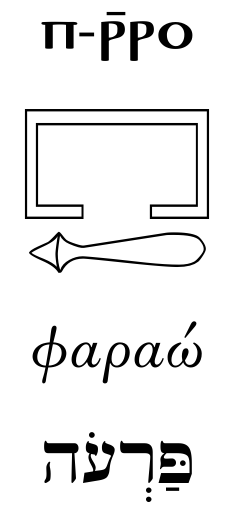
We customarily tend to refer to the early rulers of Egypt as “Pharaoh”, even though this is actually a Greek word (φαραώ), based on an Egyptian phrase: https://www.ancient.eu/pharaoh/
 
The word 'pharaoh’ is the Greek form of the Egyptian pero or per-a-a, which was the designation for the royal residence and means `Great House'. The name of the residence became associated with the ruler and, in time, was used exclusively for the leader of the people.
 
And the term was applied to the rulers of the great nation only at a late stage in Egypt’s dynastic history.
 
Tradition accredits “Menes” with being the unifying founder of Egyptian dynastic history, the first ruler of the First Dynasty.
And some suggest that Menes was the same as Hor-Aha, whose nebty name was Min, or Men. For instance: http://www.ancient-egypt.info/2012/02/hor-aha-and-founding-of-memphis.html
 
Hor-Aha … took the nebti name (the second royal name: p. 218) of Men, which means 'established', and this could be the origin of the later record of the first king as being called Menes. For present purposes we may look on Hor-Aha as the first king of the 1st Dynasty. An interesting piece of evidence is a small broken ivory label found in the tomb of Queen Nithotep at Naqada. Although schematically represented, the busy scene on this tiny piece seems to show two humans celebrating a ceremony called 'Receiving the South and the North' over an unidentified object (possibly the first representation of the later symbolic tying of papyrus and lotus stalks).

….

The king's name, meaning 'Fighting Hawk' - an allusion again to Horus - indicates his Upper Egyptian origin and rule. His adoption of Men as his nebti name for ruling over both parts is indicated on the ivory label by the fact that his Horus name (his first and principal name, p. 218) Hor-Aha, and his nebti name, Men, appear side by side. Other similar small labels from Early Dynastic tombs indicate that his was not an easy reign. There were campaigns to be fought and rebels to be subdued in Nubia, recorded on a wooden label from Abydos, and another label records his foundation of a temple to the goddess Neith at Sais in the Delta. Her warlike aspect was signified by a pair of crossed arrows and her worship continued into Roman times when she was identified with Athena at Sais. ….
 
For more on Neith (Athena), see my series:
 
Neith a goddess of greatest antiquity


That Menes and Hor-Aha were one and the same potentate is a view that I, too, favour, along with a tradition that Menes was the (somewhat ill-fated) pharaoh of Abram (= Abraham).
To that mix I have added that Menes/Hor-Aha was the biblical “Abimelech”.
An earlier article of mine on these biblico-historical correspondences has been picked up at: https://thepharaohofabraham.wordpress.com/2011/11/13/the-genealogy-of-israel-according-to-scripture/
 
…. Finally, whether the one whom Isaac calls “Abimelech” was still, in Isaac’s day, “Pharaoh” of Egypt, as he had been in former times, he was most definitely at least ruler over the Philistines at Gerar. Perhaps he ruled both lands, Egypt and Philistia. Be that as it may, the Holy Spirit has apparently provided the name of Abram’s “Pharaoh”. But one needs to respect His literary structures to discover that name. We now know his personal name: “Abimelech”.
In Hebrew it means “Father is King”.
Since Abimelech is not an Egyptian name, though (see discussion of this in 2. below), and since the other designation that we have for him is simply “Pharaoh”, that data, in itself, will not take us the next step of being able to identify this ruler in the Egyptian historical (or dynastic) records. But that our Abimelech may have – according to the progression of Ishmael’s and Isaac’s toledôt histories – ruled Egypt and then gone on
to rule Philistia, could well enable us to locate this ruler archaeologically.
Dr. John Osgood has already done much of the ‘spade work’ for us here, firstly by nailing the archaeology of En-geddi at the time of Abram (in the context of Genesis 14) to the Late Chalcolithic period, corresponding to Ghassul IV in Palestine’s southern Jordan Valley; Stratum V at Arad; and the Gerzean period in Egypt (“The Times of Abraham”, Ex Nihilo TJ, Vol. 2, 1986, pp. 77-87); and secondly by showing that, immediately following this period, there was a migration out of Egypt into Philistia, bringing an entirely new culture (= Early Bronze I, Stratum IV at Arad).
P. 86: “In all likelihood Egypt used northern Sinai as a springboard for forcing her way into Canaan with the result that all of southern Canaan became an Egyptian domain”.
This new phase would seem to correspond very nicely with the time of Narmer,
since, at this very archaeological phase, according to Osgood (ibid., p. 85):
Belonging to Stratum IV [at Arad] Amiram found a sherd with the name of Narmer …”. ….
[End of quote]
 
How might this Narmer fit into this new scheme of things?
 
Without my claiming to be certain about it, I personally like the thought that Narmer may have been the Akkadian ruler, Naram-Sin:
 
Narmer a Contemporary of Patriarch Abraham. Part Two: Narmer as Naram Sin
 
 
What would strengthen this correspondence, at least chronologically, is W. F. Albright’s remarkable thesis that Naram-Sin had actually conquered Menes of Egypt:
 
Dr. W.F. Albright’s Game-Changing Chronological Shift
 
 
All of this, if correct, would mean that, around c. 1900 BC (a conventional dating for Abram) we have a veritable clash of titans: Naram-Sin of Akkad, Menes of Egypt, and Patriarch Abram. Not to mention Melchizedek of Salem and Chedorlaomer of Elam, and so on.
A glimpse of this remarkable age has even been projected into a false C6th AD time warp:
 
Chedorlaomer and Chlodomer


I suspect that there may be much, much more to Naram-Sin the Akkadian than meets the eye.
For one, Naram-Sin strikes me now as being the stand-out candidate for the enigmatic biblical “Amraphel … king of Shinar”, contemporary of Abram. (Genesis 14:1). See e.g. my article:
 
Narmer a Contemporary of Patriarch Abraham. Part Three: (Narmer) Naram Sin as Amraphel


Part Two:

Best biblico-historical (Egyptian) syncretisms


“According to historians, King Aha ruled Egypt early after the unification of Egypt (Tyldesley, 2009, p. 22), and would have held sway over essentially all the available land. This shows that the civilization of Egypt had already developed to the point of having a powerful pharaoh who obviously had a reputation for ruthlessness as indicated by Abraham’s fear of him”.


Anne Habermehl 


A-ha, someone else has suggested that Aha may have been ruler of Egypt at the time of Abram!


And what I like about this scenario is that the same writer, Anne Habermehl, also has the visionary Joseph in place as Imhotep of the Third Egyptian Dynasty. See e.g. my article:


Era of Biblical Joseph Necessitates Re-alignment of Old Egyptian Dynasties. Part One: Joseph and Egypt’s Third Dynasty


I personally think that Abram – 1st Dynasty; Joseph – 3rd Dynasty is the correct alignment.


Anne Habermehl has written thus on the coinciding of Abram and Aha of Egypt in her article,


ANCIENT EGYPT, THE ICE AGE, AND BIBLICAL CHRONOLOGY


….

WHEN DID ABRAHAM VISIT EGYPT?


One potential synchronism between the Bible and secular history is Abraham’s temporary migration into Egypt, forced by a severe famine in Canaan (Gen. 12:10–20). The Bible does not tell us the name of Abraham’s pharaoh, and that omission introduces uncertainty as to when in Egypt’s history Abraham was there. An earliest date of about 1920 BC for Abraham’s Egyptian visit is based on 1921 BC for his entry into Canaan (Jones, 2007, p. 25). Scripture does not tell us how long Abraham was in Canaan before going to Egypt. (The LXX reduces these dates by 40 yrs. In I Kings 6:1, the time from the Exodus to beginning the building of the temple is 440 yrs. instead of 480 yrs. as in the MT.)


Abraham’s visit to Egypt would have occurred about 200 years before Joseph became vizier of Egypt. The placement of Joseph in the 3rd Dynasty of Egypt as the famous vizier Imhotep is argued by Habermehl (2013). Imhotep’s era is generally placed around 2700–2600 BC on the secular timeline (Tyldesley, 2009, p. 32). Because we know the secular timeline to be more extended than the biblical one, it would therefore be plausible that Abraham’s visit might have been about 300 yrs. (secular timeline) before Joseph. If so, this would put Abraham’s visit to Egypt somewhere around 3000 BC on the secular timeline, near the beginning of the 1st Dynasty.


There is some known ancient history that may support this date. The first king of the 1st Dynasty is generally believed to be King Aha, whose reign began c. 3000 BC on the secular timeline (Tyldesley 2009, p. 22; Shaw 2003, p. 481). During this king’s reign, the colonies of Egyptians who had been living in south Palestine abandoned their residences and returned to Egypt for unknown reasons, but then returned to Canaan later on during the 1st Dynasty (Raffaele, 2003; Porat, 1992; Watrin, 1998, pp. 1224–26). This author suggests that the same severe famine in Canaan that drove Abraham to Egypt may have caused these Egyptians to return home at this time.


We also note that Abraham did not appear to have the option of circumventing this powerful pharaoh. For his own personal safety (because of Sarah’s beauty), Abraham might have liked to pasture his animals in a section of Egypt that was not under this pharaoh’s rule. But the fact that he did not do so would indicate that he was obligated to deal with this particular pharaoh. According to historians, King Aha ruled Egypt early after the unification of Egypt (Tyldesley, 2009, p. 22), and would have held sway over essentially all the available land.

This shows that the civilization of Egypt had already developed to the point of having a powerful pharaoh who obviously had a reputation for ruthlessness as indicated by Abraham’s fear of him.


Placing Abraham in Egypt near the beginning of the 1st Dynasty would be earlier in Egypt’s history than many scholars have led us to believe. The well-respected Cook (1871, p. 447) thought Abraham was in Egypt between the 11th and 13th Dynasty. Ashton & Down (2006, p. 37) put Abraham in Egypt in the time of Kufu (4th Dynasty).However, those who place Abraham later on in Egyptian history have a problem, in that they have to fit even more historical events into the period between the Ice Age and Abraham’s visit. ….


[End of quote]


The article then goes horribly wrong, I believe, in locating the prophet Job to only “several generations after Abraham”:


We can conclude that by Abraham’s time the Ice Age was long past because it had ended earlier at the time of the Nile’s wild flow, and all development of Egypt’s civilization had taken place after that. This also means that Job did not live during the Ice Age, as is believed by various writers (e.g., Northrup, 1996). Job lived several generations after Abraham (Job 42:17 LXX). ….

[End of quote]


The prophet Job live into the era of the “Chaldeans” (Job 1:17), conventionally more than a millennium after Abraham. See e.g. my article:


Job's Life and Times


Job was Tobias, son of Tobit, of the C8th BC (conventional dating).

Tuesday, June 11, 2019

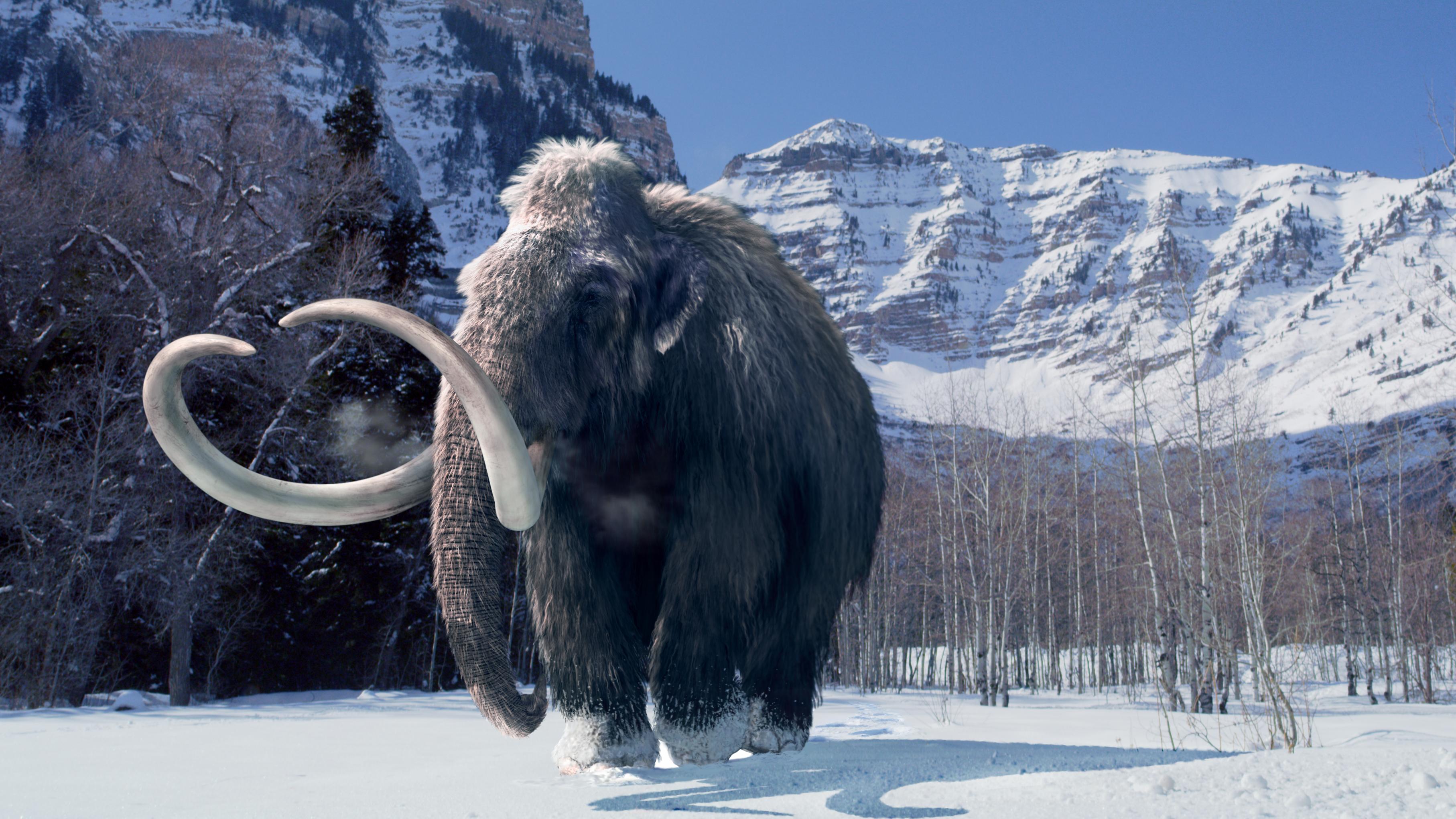
'Creationists’ favour only the one Ice Age

Image result for ice age


“There are strong indications that there was only one ice age. As discussed previously,

the requirements for an ice age are very stringent. The problem grows to impossibility,

when more than one is considered”.
 
Michael Oard


Key ‘Creationist’ references on this subject appear to be (i) Michael Oard’s 1987 paper:

https://www.icr.org/article/ice-age-genesis-flood/


The Ice Age and the Genesis Flood


as well as (ii) his: “An Ice Age Caused by the Genesis Flood” (1990).

According to Creationist Anne Habermehl, in “Where in the World Is the Tower of Babel?”

https://answersingenesis.org/tower-of-babel/where-in-the-world-is-the-tower-of-babel/ Oard’s research on this particular subject constitutes “the current creationist model”.

She also writes in ANCIENT EGYPT, THE ICE AGE, AND BIBLICAL CHRONOLOGY (2013) that: “Our best-known creationist Ice Age model has now been around since 1990, when Oard published An Ice Age Caused by the Genesis Flood”.

https://www.academia.edu/39176159/Ancient_Egypt_the_Ice_Age_and_Biblical_Chronology
 
Habermehl further wrote in her “Babel” article (2011), with reference to Oard:

….

In the period immediately after the worldwide Flood, when the waters had settled, the world ocean level was higher than it is today. But then a great Ice Age settled in, considered by creationists to be most likely caused by post-Flood conditions, and moisture from the warm oceans started to freeze on the continents.

During this ice-building time, so much water froze in very thick sheets that the ocean levels lowered drastically.7 When the Ice Age ended, a great deal of the ice melted, and the world ocean level rose back up to approximately its current level. The total time estimated for the overall Ice Age, including ice buildup and meltdown, is about 700 years, according to the current creationist model proposed by Oard (2006); advances and retreats of the ice at its edges is considered to account for the geological formations that make evolutionists believe that there were multiple separate ice ages. (For further information on the description and modeling of this ice age from the creationist point of view see Oard 1990, passim; Oard 2004, pp. 107–109; Snelling 2009, pp. 769–778; Vardiman 2001, pp. 81–91.) Secular geologists, who claim over two billion years for their entire series of ice ages and interglacials, obviously describe the Ice Age quite differently from creationists. (For further description of the standard secular ice ages, see for example Cattermole and Moore 1985, p. 197; Imbrie and Imbrie 1979, passim; Muller and MacDonald 2000, passim; Ray 1999.) ….

[End of quote]

 
Here, now, is a relevant section from M. Oard’s “The Ice Age and the Genesis Flood” (1987):
 
ONE ICE AGE
 
Earth scientists believe there were many ice ages—perhaps more than 30—in regular succession during the late Cenozoic based on oxygen isotope fluctuations in deep-sea cores. 15 However, the ocean results have many difficulties, and sharply conflict with the long-held four ice-age continental scheme. Before the early 20th century, the number of ice ages was much debated. Some scientists believed in only one ice age, but the sediments are complex and have evidence of anywhere from one to four, or possibly more till sheets, separated by non-glacial deposits. Four ice ages became established mainly from gravel terraces in the Alps, and reinforced by soil stratigraphy. Much has been learned about glacial behavior and sedimentation since then. The Alps terraces are now viewed as possibly ". . . a result of repeated tectonic uplift cycles—not widespread climatic changes per se." 16 Variously weathered "interglacial soils" between till sheets are complex, and practically always have the top organic horizon missing. It is difficult to know whether they are really soils. 17 Besides, the rate of modern soil formation is unknown, and depends upon many complex factors, like the amount of warmth, moisture, and time. 18 Therefore, the number of glaciations is still an open question.
 
There are strong indications that there was only one ice age. As discussed previously, the requirements for an ice age are very stringent. The problem grows to impossibility, when more than one is considered. Practically all the ice-age sediments are from the last, and these deposits are very thin over interior areas, and not overly thick at the periphery. Till can sometimes be laid down rapidly, especially in end moraines. Thus the main characteristics of the till favor one ice age. Pleistocene fossils are rare in glaciated areas, which is mysterious, if there were many interglacials.

Practically all the megafaunal extinctions were after the last—a difficult problem if there was more than one.
 
One dynamic ice age could explain the features of the till along the periphery by large fluctuations and surges, which would cause stacked till sheets. 19 Organic remains can be trapped by these oscillations. 20 Large fluctuations may be caused by variable continental cooling, depending upon volcanic activity. In addition, most of the snow and ice should accumulate at the periphery, closest to the main storm tracks.

Large surface slopes and warm basal temperatures at the edge are conducive to rapid glacial movement. 21

 
In summary, the mystery of the ice age can be best explained by one catastrophic ice age as a consequence of the Genesis Flood. ….

[End of quote]


In her article, ANCIENT EGYPT, THE ICE AGE, AND BIBLICAL CHRONOLOGY, Habermehl will discuss something that has so far been very much neglected, sadly, namely: the Ice Age in relation to the early chronology of ancient Egypt and Abraham.

Thus she commences:
 
ABSTRACT


The history, archaeology, geography, and geology of ancient Egypt are examined with respect to the post-Flood Ice Age. It is shown that the Ice Age must have ended before the formation of the Nile Delta, and therefore well before the beginnings of Egyptian civilization and Abraham’s visit to Egypt. It is shown that more time for events between the Flood and Abraham is needed than the Masoretic timeline allows; the longer chronology of the Septuagint is therefore most likely correct.


INTRODUCTION


Creationist historians and archaeologists have not generally considered the role of the Ice Age and related geology in developing their views of the past in the biblical lands of the Middle East. Conversely, creationist scientists have largely based their models of the post-Flood period and Ice Age on geological studies of North America without regard to the known history and archaeology of the Middle East. As a result, the two groups have gone their individual ways without much exchange of knowledge between them. This dichotomy is especially evident with respect to the early history of Egypt and the Ice Age.


Towards the end of this paper, Habermehl will suggest that “changes … are going to be needed” to the previously suggested models:
 
According to the Oard Ice Age model, the ice would still have been in place in the northern latitudes for most of Abraham’s life, with the meltdown starting only about 25 yrs. before his death (Abraham was born around 2000 BC, and died 175 yrs. later) (Jones, 2007, p. 47). However, as we have seen earlier in this paper, both formation of the Nile Delta and the earliest beginnings of pharaonic civilization took place only after the period of the ice meltdown; and Abraham’s visit to Egypt occurred subsequent to these events. We also note that Jacob and his family settled on the Nile Delta in Goshen when they entered Egypt in about 1700 BC (Jones,2007, p. 66); at that time, by Oard’s model, the Delta would still have been in the formation stage during the Ice Age meltdown. In fact, we know that the Delta was then the best pastureland in Egypt (Gen. 47:6). The obvious conclusion is that the currently accepted model of the Ice Age must be incorrect in its placement between 2350 BC and 1650 BC. This now leads to a major chronology problem. Between the Flood and Abraham’s visit to Egypt we count 425–35 yrs. (MT timeline), depending on how soon Abraham went to Egypt after arriving in Canaan. (Whether we calculate 215 or 430 yrs. for the Children of Israel in Egypt does not change the number of years between the Flood and Abraham). There simply isn’t enough time for a 700-yr. Ice Age, repopulation along the Nile (Neolithic era), and development of Predynastic society. This means that anyone who has been accepting the current model of the Ice Age as well as the standard MT timeline has been holding an untenable position. Changes of some sort are going to be needed, whether in the Ice Age model, the timeline, or both, to solve this chronological difficulty. ….


Wednesday, June 5, 2019

Very Young Tyrannosaurus Rex Dinosaur


Framed Close-up of Tyrannosaurus Rex dinosaur with Mouth Open Print 


Theory of Evolution Cartoonishly Dumb


Part Three:

Very Young Tyrannosaurus Rex Dinosaur


“Researchers working on ancient DNA had claimed previously that they had recovered DNA millions of years old, but subsequent work failed to validate

the results. The only widely accepted claims of ancient molecules were

no more than several tens of thousands of years old”.


Mary H. Schweitzer


Part One of this series:


re-visited a series of letters by Polish professor Maciej Giertych exposing evolution:


The theory of evolution is maintained for ideological reasons and not because scientific evidence supports it. If it were not for the lack of another atheistic explanation of the origin of life and of all its forms, this theory would have been dismissed by scientists long ago. In fact most scientists prefer not to get involved in the controversy over evolution because of the possible consequences to their careers. A recent example of such consequences for Dr. Rick Von Sternberg of the Smithsonian Institution can be seen discussed in a National Review article[1]. Most biologists can work in their own fields and advance academically without ever mentioning evolution and most choose not to mention it. ….


Part Two:


recalled, amongst other things, that classic quote about evolution by G. K. Chesterton:


“The evolutionists seem to know everything about the missing link

except the fact that it is missing”.


Here now, in Part Three, is another telling piece of evidence:


Evolution Falsified, Once Again


Evolution

Tuesday, 02 August 2011 11:26


R. Sungenis: In this article, field researcher Mary H. Schweitzer writes in the most prestigious science magazine today, Scientific American, about her discovery of soft tissue and blood cells in the bone of a Tyrannosaurus rex dinosaur that, according to modern evolutionary dating techniques, is about 70 million years old. If it hasn’t struck you already, science tells us that organic tissue could barely last 7,000 years, much less 10,000 times 7,000 years. So what does science do with this anomaly? It pleads ignorance, and it does so while it tries to find a way to dismiss the evidence. When Ms. Schweitzer brought her evidence to Jack Horner, curator of paleontology at the museum and one of the world’s foremost dinosaur authorities, after a long look under the microscope at the nucleated blood cells of the T-Rex, he said to Ms. Schweitzer: “So prove to me they aren’t.” That about sums up the history of the bias and deliberate attempts to twist the evidence in favor of evolution that occurs on a daily basis in our high school and college classrooms. Whereas Ms. Schweitzer’s find should have been hailed as one of the most astounding discoveries in history since Darwin wrote his book on the evolutionary hypothesis in 1879, she is basically assigned the impossible task of finding a way to dismiss the blood cell’s prima facie denial of evolution, and implied in that “request” is the fact that she will lose her job if she doesn’t seek an alternative answer. What does Ms. Schweitzer decide to do? The next sentence in her story tells us loud and clear. She capitulates to the reigning paradigm of modern science, without question: “It was an irresistible challenge, and one that has helped frame how I ask my research questions, even now.” So Ms. Schweitzer, in order to continue to be a member of the status quo and receive her pay check from the powers-that-be, remains an ardent evolutionist, seeking to deny the common sense knowledge her heart and mind scream at her about what it means to see blood cells in dinosaur remains.


“Blood From Stone”


By Mary H. Schweitzer

From Scientific American, December 2010


Peering through the microscope at the thin slice of fossilized bone, I stared in disbelief at the small red spheres a colleague had just pointed out to me. The tiny structures lay in a blood vessel channel that wound through the pale yellow hard tissue. Each had a dark center resembling a cell nucleus. In fact, the spheres looked just like the blood cells in reptiles, birds and all other vertebrates alive today except mammals, whose circulating blood cells lack a nucleus. They couldn’t be cells, I told myself. The bone slice was from a dinosaur that a team from the Museum of the Rockies in Bozeman, Mont., had recently uncovered a Tyrannosaurus rex that died some 67 million years ago--and everyone knew organic material was far too delicate to persist for such a vast stretch of time.

For more than 300 years paleontologists have operated under the assumption that the information contained in fossilized bones lies strictly in the size and shape of the bones themselves. The conventional wisdom holds that when an animal dies under conditions suitable for fossilization, inert minerals from the surrounding environment eventually replace all of the organic molecules—such as those that make up cells, tissues, pigments and proteins—leaving behind bones composed entirely of mineral. As I sat in the museum that afternoon in 1992, staring at the crimson structures in the dinosaur bone, I was actually looking at a sign that this bedrock tenet of paleontology might not always be true—though at the time, I was mostly puzzled. Given that dinosaurs were nonmammalian vertebrates, they would have had nucleated blood cells, and the red items certainly looked the part, but so, too, they could have arisen from some geologic process unfamiliar to me.

Back then I was a relatively new graduate student at Montana State University, studying the microstructure of dinosaur bone, hardly a seasoned pro. After I sought opinions on the identity of the red spheres from faculty members and other graduate students, word of the puzzle reached Jack Horner, curator of paleontology at the museum and one of the world’s foremost dinosaur authorities. He took a look for himself. Brows furrowed, he gazed through the microscope for what seemed like hours without saying a word. Then, looking up at me with a frown, he asked, “What do you think they are?” I replied that I did not know, but they were the right size, shape and color to be blood cells, and they were in the right place, too. He grunted, “So prove to me they aren’t.” It was an irresistible challenge, and one that has helped frame how I ask my research questions, even now.

Since then, my colleagues and I have recovered various types of organic remains—including blood vessels, bone cells and bits of the fingernail-like material that makes up claws—from multiple specimens, indicating that although soft-tissue preservation in fossils may not be common, neither is it a one-time occurrence. These findings not only diverge from textbook description of the fossilization process, they are also yielding fresh insights into the biology of bygone creatures. For instance, bone from another T.rex specimen has revealed that the animal was a female that was “in lay” (preparing to lay eggs) when she died—information we could not have gleaned from the shape and size of the bones alone. And a protein detected in remnants of fibers near a small carnivorous dinosaur unearthed in Mongolia has helped establish that the dinosaur had feathers that, at the molecular level, resembled those of birds.

Our results have met with a lot of skepticism—they are, after all, extremely surprising. But the skepticism is a proper part of science, and I continue to find the work fascinating and full of promise. The study of ancient organic molecules from dinosaurs has the potential to advance understanding of the evolution and extinction of these magnificent creatures in ways we could not have imagined just two decades ago.


FIRST SIGNS

Extraordinary claims, as the old adage goes, require extraordinary evidence. Careful scientists make every effort to disprove cherished hypotheses before they accept that their ideas are correct. Thus, for the past 20 years I have been trying every experiment I can think of to disprove the hypothesis that the materials my collaborators and I have discovered are components of soft tissues from dinosaurs and other long-gone animals.

In the case of the red microstructures saw in the T.rex bone, I started by thinking that if they were related to blood cells or to blood cell constituents (such as molecules of hemoglobin or heme that had clumped together after being released from dying blood cells), they would have persisted in some, albeit possibly very altered, form only if the bones themselves were exceptionally well preserved. Such tissue would have disappeared in poorly preserved skeletons. At the macroscopic level, this was clearly true. The skeleton, a nearly complete specimen from eastern Montana—officially named MOR 555 and affectionately dubbed “Big Mike”—includes many rarely preserved bones. Microscope examination of thin sections of the limb bones revealed similarly pristine preservation. Most of the blood vessel channels in the dense bone were empty, not filled with mineral deposits as is usually the case with dinosaurs. And those ruby microscopic structures appeared only in the vessel channel, never in the surrounding bone or in sediments adjacent to the bones, just as should be true of blood cells.

Next, I turned my attention to the chemical composition of the blood cell look-alikes. Analyses showed that they were rich in iron, as red blood cells are, and that the iron was specific to them. Not only did the elemental makeup of the mysterious red things (we nicknamed them LLRTs, “little round red things”) differ from that of the bone immediately surrounding the vessel channels, it was also utterly distinct from that of the sediments in which the dinosaur was buried. But to further test the connection between the red structures and blood cells, I wanted to examine my samples for heme, the small iron-containing molecule that gives vertebrate blood its scarlet hue and enables hemoglobin proteins to carry oxygen from the lungs to the rest of the body. Heme vibrates, or resonates, in telltale patterns when it is stimulated by tuned lasers, and because it contains a metal center, it absorbs light in a very distinct way. When we subjected bone samples to spectroscopy tests-which measure the light that a given material emits, absorbs or scatters-our results showed that somewhere in the dinosaur’s bone were compounds that were consistent with heme.

One of the most compelling experiments we conducted took advantage of the immune response. When the body detects an invasion by foreign, potentially harmful substances, it produces defensive proteins called antibodies that can specifically recognize, or bind to, those substances. We injected extracts of the dinosaur bone into mice, causing the mice to make antibodies against the organic compounds in the extract. When we then exposed these antibodies to hemoglobin from turkeys and rats, they bound to the hemoglobin--a sign that the extracts that elicited antibody production in the mice had included hemoglobin or something very like it. The antibody data supported the idea that Big Mike’s bones contained something similar to the hemoglobin in living animals.

None of the many chemical an immunological tests we performed disproved our hypothesis that the mysterious red structures visible under the microscope were red blood cells from a T. rex. Yet we could not show that the hemoglobinlike substance was specific to the red structures—the available techniques were not sufficiently sensitive to permit such differentiation. Thus, we could not claim definitively that they were blood cells. When we published our findings in 1997, we drew our conclusions conservatively, stating that hemoglobin proteins might be preserved and that the most likely source of such proteins was the cells of the dinosaur. The paper got very little notice


THE EVIDENCE BUILDS

Through the T. rex work, I began to realize just how much fossil organics stood to reveal about extinct animals. If we could obtain proteins, we could conceivably decipher the sequence of their constituent amino acids, much as geneticists sequence the “letters” that make up DNA. And like DNA sequences, protein sequences contain information about evolutionary relationships between animals, how species change over time and how the acquisition of new genetic traits might have conferred advantages to the animals possessing those features. But first I had to show that ancient proteins were present in fossils other than the wonderful T.rex we had been studying. Working with Mark Marshall, then at Indiana University, and wit h Seth Pincus and John Watt, both at Montana State during this time, I turned my attention to two well-preserved fossils that looked promising for recovering organics.

The first was a beautiful primitive bird named Rahonavis that paleontologists form Stony Brook University and Marcalester College had unearthed form deposits in Madagascar dating to the Late Cretaceous period, around 80 million to 70 million years ago. During excavation they had noticed a white, fibrous material on the skeleton’s toe bones, No other bone in the quarry seemed to have the substance, nor was it present on any of the sediments there, suggesting that it was part of the animal rather than having been deposited on the bones secondarily. They wondered whether the material might be akin to the strong sheath made of keratin protein that covers the toe bones of living birds, forming their claws, and asked for my assistance.

Keratin proteins are good candidates for preservation because they are abundant in vertebrates, and the composition of this protein family makes them very resistant to degradation—something that is nice to have in organs such as skin that are exposed to harsh conditions. They come in two main types: alpha and beta. All vertebrates have alpha keratin, which in humans makes up hair and nails and helps the skin to resist abrasion and dehydration. Beta keratin is absent from mammals and occurs only in birds and reptiles among living organisms.

To test for keratins in the white material on the Rahonavis toe bones, we employed many of the same techniques I had used to study T. rex. Notably, antibody tests indicated the presence of both alpha and beta keratin. We also applied additional diagnostic tools. Other analyses, for instance, detected amino acids that were localized to the toe-bone covering and also detected nitrogen (a component of amino acids) that was bound to other compounds much as proteins bind together in living tissues, including keratin. The results of all our tests supported the notion that the cryptic white material covering the ancient bird’s toe bones included fragments of alpha and beta keratin and was the remainder of its once lethal claws.

The second specimen we probed was a spectacular Late Cretaceous fossil that researchers from the American Museum of Natural History in New York City had discovered in Mongolia. Although the scientists dubbed the animal Shuvuuia deserti, or “desert bird,” it was actually a small carnivorous dinosaur. While cleaning the fossil, Amy Davidson, a technician at the museum, noticed small white fibers in the animal’s neck region. She asked me if I could tell if they were remnants of feathers. Birds are descended from dinosaurs, and fossil hunters have discovered a number of dinosaur fossils that preserve impressions of feathers, so in theory the suggestion that Shuvuuia had a downy coat was plausible. I did not expect that a structure as delicate as a feather could have endured the ravages of time, however. I suspected the white fibers instead came from modern plants or from fungi. But I agreed to take a closer look.

To my surprise, initial tests ruled out plants or fungi as the source of the fibers. Moreover, subsequent analyses of the microstructure of the strange white strands pointed to the presence of keratin. Mature feathers in living birds consist almost exclusively of beta keratin. If the small fibers on Shuvuuia were related to feathers, then they should harbor beta keratin alone, in contrast to the claw sheath of Rahonavis, which contained both alpha and beta keratin. That, in fact is exactly what we found when we conducted our antibody tests—results we published in 1999.


EXTRAORDINARY FINDS

By now I was convinced that small remnants of original proteins could survive in extremely well preserved fossils and that we had the tools to identify them. But many in the scientific community remained unconvinced. Our findings challenged everything scientists thought they knew about the breakdown of cells and molecules. Test-tube studies of organic molecules indicated that proteins should not persist more than a million years or so; DNA had an even shorter life span. Researchers working on ancient DNA had claimed previously that they had recovered DNA millions of years old, but subsequent work failed to validate the results. The only widely accepted claims of ancient molecules were no more than several tens of thousands of years old. In fact, one anonymous reviewer of a paper I had submitted for publication in a scientific journal told me that this type of preservation was not possible and that I could not convince him or her otherwise, regardless of our data.

In response to this resistance, a colleague advised me to step back a bit and demonstrate the efficacy of our methods for indentifying ancient proteins in bones that were old, but not as old as dinosaur bone, to provide a proof of principle. Working with analytical chemist John Asara of Harvard University, I obtained proteins form mammoth fossils that were estimated to be 300,000 to 600,000 years old. Sequencing of the proteins using a technique called mass spectrometry indentified them unambiguously as collagen, a key component of bone, tendons, skin and other tissues. The publication of our mammoth results in 2002 did not trigger much controversy. Indeed, the scientific community largely ignored it. But our proof of principle was about to come in very handy.

The next year a crew from the Museum of the Rockies finally finished excavating another T. rex skeleton, which at 68 million years old is the oldest one to date. Like the younger T. rex, this one—called MOR 1125 and nicknamed “Brex,” after discoverer Bob Harmon—was recovered from the Hell Creek Formation in eastern Montana. The site is isolated and remote, with no access for vehicles, so a helicopter ferried plaster jackets containing excavated bones from the site to the camp. The jacket containing the leg bones was too heavy for the helicopter to lift. To retrieve them, then, the team broke the jacket, separated the bones and rejacketed them. But the bones are very fragile, and when the original jacket was opened, many fragments of bone fell out. These were boxed up for me. Because my original T. rex studies were controversial, I was eager to repeat the work on a second T. rex. The new find presented the perfect opportunity.

As soon as I laid eyes on the first piece of bone I removed from that box, a fragment of thighbone, I knew the skeleton was special. Lining the internal surface of this fragment was a thin, distinct layer of a type of bone that had never been found in dinosaurs. This layer was very fibrous, filled with blood vessel channels, and completely different in color and texture from the cortical bone that constitutes most of the skeleton. “Oh, my gosh, it’s a girl—and it’s pregnant!” I exclaimed to my assistant, Jennifer Wittmeyer, She looked at me like I had lost my mind. But having studied bird physiology, I was nearly sure that this distinctive feature was medullary bone, a special tissue that appears for only a limited time (often for just about two weeks), when birds are in lay, and that exists to provide an easy source of calcium to fortify the eggshells.

One of the characteristics that sets medullary bone apart from other bone types is the random orientation of its collagen fibers, a characteristic that indicates very rapid formation. (This same organization occurs in the first bone laid down when you have a fracture—that is why you feel a lump in healing bone.) The bones of a modern-day bird and all other animals can be demineralized using mild acids to reveal the telltale arrangement of the collagen fibers. Wittmeyer and I decided to try to remove the minerals. If this was medullary bone and if collagen was present, eliminating the minerals should leave behind randomly oriented fibers. As the minerals were removed, they left a flexible and fibrous clump of tissue. I could not believe what we were seeing. I asked Wittmeyer to repeat the experiment multiple times. And each time we placed the distinctive layer of bone in the mild acid solution, fibrous stretchy material remained—just as it does when medullary bone in birds is treated in the same way.

Furthermore, when we then dissolved pieces of the denser, more common cortical bone, we obtained more soft tissue. Hollow, transparent, flexible, branching tubes emerged from the dissolving matrix—and they looked exactly like blood vessels. Suspended inside the vessels were either small, round red structures or amorphous accumulations of red material. Additional demineralization experiments revealed distinctive-looking bone cells called osteocytes that secrete the collagen and other components that make up the organic part of bone. The whole dinosaur seemed to preserve material never seen before in dinosaur bone.

When we published our observations in Science in 2005, reporting the presence of what looked to be collagen, blood vessels and bone cells, the paper garnered a lot of attention, but the scientific community adopted a wait-and see attitude. We claimed only that the material we found resembled these modern components—not that they were one and the same. After millions of years, buried in sediments and exposed to geochemical conditions that varied over time, what was preserved in these bones might bear little chemical resemblance to what was there when the dinosaur was alive. The real value of these materials could be determined only if their composition could be discerned. Our work had just begun.

Using all the techniques honed while studying Big Mike, Rathonavis, Shuvuuia and the mammoth, I began an in-depth analysis of this T.rex’s bone in collaboration with Asara, who had refined the purification and sequencing methods we used in the mammoth study and was ready to try sequencing the dinosaur’s much older proteins. This was a much harder exercise, because the concentration of organics in the dinosaur was orders of magnitude less than in the much younger mammoth and because the proteins were very degraded. Nevertheless, we were eventually able to sequence them. And, gratifyingly, when our colleague Chris Organ of Harvard compared the T.rex sequences with those of a multitude of other organisms, he found that they grouped most closely with birds, followed by crocodiles—the two groups that are the closest living relatives of dinosaurs.


CONTROVERSY AND ITS AFTERMATH

Our papers detailing the sequencing work, published in 2007 and 2008, generated a firestorm of controversy, most of which focused on our interpretations of the sequencing (mass spectrometry) data. Some dissenters charged that we had not produced enough sequences to make our case; others argued that the structures we interpreted as primeval soft tissues were actually biofilm—“slime” produced by microbes that had invaded the fossilized bone. There were other criticisms, too. I had mixed feelings about their feedback. On one hand, scientists are paid to be skeptical and to examine remarkable claims with rigor. On the other hand, science operates on the principle of parsimony—the simplest explanation for all the data is assumed to be the correct one. And we had supported our hypothesis with multiple lines of evidence

Still, I knew that a single gee-whiz discovery does not have any long-term meaning to science. We had to sequence proteins form other dinosaur finds. When a volunteer accompanying us on a summer expedition found bones from and 80-million-year-old plant-eating duckbill dinosaur called Brachylophosaurus canadensis, or “Brachy,” we suspected the duckbill might be a good source of ancient proteins even before we got its bones out of the ground. Hoping that is might contain organics, we did everything we could to free it from the surrounding sandstone quickly while minimizing its exposure to the elements. Air pollutants, humidity fluctuations and the like would be very harmful to fragile molecules, and the longer the bone was exposed, the more likely contamination and degradation would occur.

Perhaps because of this extra care—and prompt analyses—both the chemistry and the morphology of this second dinosaur were less altered than Brex’s. As we had hoped, we found cells embedded in a matrix of white collagen fibers in the animal’s bone. The cells exhibited long, thin, branchlike extensions that are characteristic of osteocytes, which we could trace from the cell body to where they connected to other cells. A few of them even contained what appeared to be internal structures, including possible nuclei.

Furthermore, extracts of the duckbill’s bone reacted with antibodies that target collagen and other proteins that bacteria do not manufacture, refuting the suggestion that our soft-tissue structures were merely biofilms. In addition, the protein sequences we obtained from the bone most closely resembled those of modern birds, just as Brex’s did. And we sent samples of the duckbill’s bone to several different labs for independent testing, all of which confirmed our results. After we reported these findings in Science in 2009, I heard no complaints.

Our work does not stop here. There is still so much about ancient soft tissues that we do not understand. Why are these materials preserved when all our models say they should be degraded? How does fossilization really occur? How much can we learn about animals from preserved fragments of molecules? The sequencing work hints that analyses of this material might eventually help to sort out how extinct species are related—once we and others build up bigger libraries of ancient sequences, and sequences from living species, for comparison, As these databases expand, we may be able to compare sequences to see how member of lineage changed at the molecular level. And by rooting these sequences in time, we might be able to better understand the rate of this evolution. Such insights will help scientists to piece together how dinosaurs and other extinct creatures responded to major environmental changes, how they recovered from catastrophic events, and ultimately what did them in.


Comments


+5#12011-08-11 10:19

Ms. Mary Schweitzer asks, "Why are these materials preserved when all our models say they should be degraded?" A simple $600 experiment test for C-14 in one of 10 Accelerated Mass Spectrometer (AMS) laboratories in the USA would answer that. The half life for the radioactive decay of C-14 is 5,730 years and AMS equipment can detect each atom of C-14 with reasonable accuracy to about eight half-lives or about 50,000 years.

Since 1990 there has been a steady stream of reports of finding C-14 in dinosaur bones and other “ancient” fossils with a definitive report being published in a book written in 2009 entitled "Evolutionism: The Decline of an Hypothesis." C-14 dates of 23,170 ±170 to 30,890 ± 200 years were reported for dinosaur bone collagen in the paper entitled: “Recent C-14 Dating of Fossils Including Dinosaur Bone Collagen. The results appear to be a confirmation of rapid formation of the geologic column as modern sedimentology studies have predicted.”


....


Monday, June 3, 2019

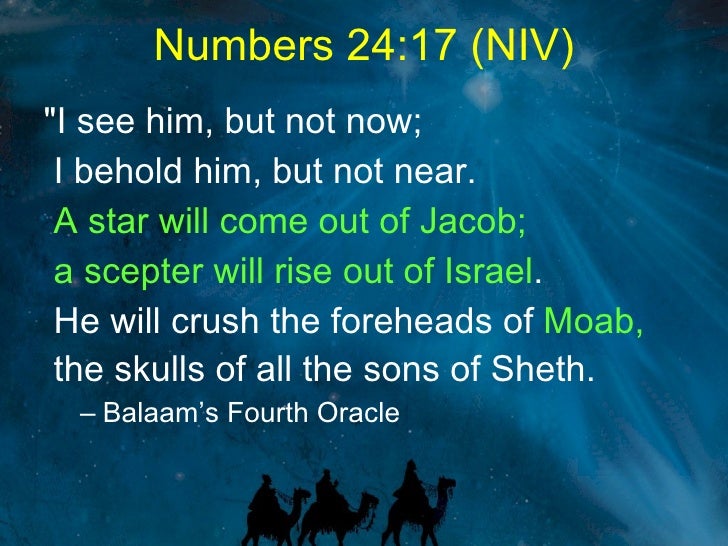
‘There shall come a Star out of Jacob’


 Image result for star out of jacob
 
 
The Law, we are told by St. Paul, has “a shadow of the good things to come”
(Hebrews 10:1). The various ordinances and feasts of the Old Testament,
if properly understood, are found, according to G. Mackinlay, “to refer to
and foreshadow many events and doctrines of the New Testament”.


Previously I have written (summarising Lieutenant-Colonel G. Mackinlay’s important book, The Magi: How They Recognised Christ's Star, Hodder and Stoughton, 1897):
 
….
Chapter Three: “A Star … out of Jacob”
 
Let us now turn again to the method of inferences from harmonies, that we have used in the last two chapters, in order to determine, with greater precision than has been attained do far, the date of Our Lord’s Nativity. Despite Scaliger, who said that God alone, not man, can determine the true day of the Nativity (Scaliger, as quoted by Hales, Chron., Vol. 1, p. 199), we are prepared to accept a result arising clearly and consistently from the method of harmonies – should such a result be achieved – provided, of course, that the result does not clash with, or contradict, any well–established fact of history. And we can look upon this further application of the method of inferences from harmonies as being a further test of the reliability of this method of inference.
We shall investigate historical methods later on.
 
Mackey’s comment: Actually the needed revision of late BC-early AD history, not yet effected, may be far more radical than earlier writers, like Mackinlay, could possibly have imagined. As Mackinlay saw it, it was universally accepted that Our Lord’s Nativity could not have been earlier than the beginning of BC 10, or later than the end of BC 5. The date is today generally given as being somewhere between BC 8-4.
But see my radical revision of all of this:
 
A New Timetable for the Nativity of Jesus Christ
 
 
“Chronologists have never really managed to sort out a satisfactory biblical timeline for this Roman scenario, with the Nativity currently having to be positioned in BC time (8 BC, 4 BC) to accommodate a faulty Herodian chronology.
But it is Jesus Christ the Lord of History, the Alpha and the Omega (the Aleph and the Tau), and not king Herod, who determines the end point of BC time and the beginning of AD (Anno Domini) time”.
 
In pursuing these new inferences now for the earlier part of Our Lord’s life, we once again follow our reliable guide Mackinlay who commences by establishing “the greater probability” of the following two facts:
 
(a) That the Nativity of Our Lord was at least five months after the beginning of a period of shining of the morning star, and,
(b) That the Nativity was at a Feast of Tabernacles (p. 140).
 
Firstly, we investigate Mackinlay’s reason for believing that our Lord’s Nativity was:
 
(a) Five months after a period of shining.
To begin with, we must consider what reason there is for supposing that the morning star was shining at all when Our Lord was born. In Malachi 3:1 … St. John the Baptist is referred to under the figure of the morning star, as the forerunner of the Christ. But the morning star itself may be called “My messenger who shall prepare the way before Me”. It is not unusual for inanimate objects thus to be spoken of in Scripture, for instance in Psalm 88:38 we have “the faithful witness in the sky”, and in Psalm 148:3 the sun, moon and stars of light are exhorted to praise God. Consequently, as Mackinlay has explained it (p. 141), “we can reasonably suppose that the Morning Star was shining at the Nativity”. Furthermore, he adds, if the morning star were the herald of the coming One, it is fitting to imagine that a somewhat prolonged notice should be given; for “it would be more dignified and stately for the one to precede the other by a considerable interval, than that both should come almost together”.
We shall find Mackinlay’s supposition of a prolonged heralding by the morning star borne out by the following inference. According to the principle of metaphors being taken from things present, we could infer that the morning star was actually shining when Our Lord (in Matthew 11:10), quoting Malachi 3:1, spoke of the Baptist as “My messenger … before My face”. Consistently following the same line of thought, we may reasonably infer that the morning star was also shining more than thirty years earlier when Zechariah quoted the same scriptural verse – i.e. Malachi 3:1 – at the circumcision of his son, John (Luke 1:76).
Even had this appropriate passage not been quoted at the time, Mackinlay suggests (p. 142), “we might have inferred that the herald in the sky would harmoniously have been shining at the birth of the human herald”.
Mackinlay further suggests from his inference that both Our Lord and St. John were born when the morning star was shining, that “both must have been born during the same period of its shining”. [He shows this in his charts]. The Annunciation to Mary was made by the angel Gabriel in the sixth month after the announcement to Zechariah (Luke1:13, 24, 26); and so it follows that the Baptist was born five to six months before Our Lord. Since Mackinlay’s charts indicate that the periods of shining are separated from each other by intervals of time greater than six months, then both Our Lord and his herald must have been born during the same period of shining.
Consequently Our Lord was born at least five months after the beginning of a period of shining of the morning star. ….
 
(b) At a Feast of Tabernacles
The Law, we are told by St. Paul, has “a shadow of the good things to come” (Hebrews 10:1). The various ordinances and feasts of the Old Testament, if properly understood, are found, according to Mackinlay, “to refer to and foreshadow many events and doctrines of the New Testament” (p. 143). Again, A. Gordon remarks that: “Many speak slightingly of the types, but they are as accurate as mathematics; they fix the sequence of events in redemption as rigidly as the order of sunrise and noontide is fixed in the heavens” (The Ministry of the Spirit, p. 28).
The deductions drawn from Gospel harmonies attest the truth of his statement.
We have already observed that the Sabbath Year began at the Feast of Tabernacles; the great feasts of Passover and Weeks following in due course. Our Lord’s death took place at the Passover (Matthew 27:50), probably, Mackinlay believes, “at the very hour when the paschal lambs were killed”.
“Our Passover … has been sacrificed, even Christ” (1 Corinthians 5:7); the great Victim foretold during so many ages by the yearly shedding of blood at that feast. The first Passover at the Exodus was held on the anniversary of the day when the promise – accompanied by sacrifice – was given to Abraham, that his seed would inherit the land of Canaan (Exodus12:41; Genesis 15:8-18).
Our Lord rose from the dead on the day after the Sabbath after the Passover (John 20:1); the day on which the sheaf of first fruits, promise of the future harvest, was waved before God (Leviticus 23:10, 11). Hence we are told by St. Paul that as “Christ the first-fruits” (1 Corinthians 15:20. 23) rose, so those who believe in him will also rise afterwards. This day was the anniversary of Israel’s crossing through the Red Sea or “Sea of Reeds’ (Exodus 12-14), and, as in the case of the Passover, it was also a date memorable in early history, being the day when the Ark came to rest on the mountains of Ararat (Genesis 8:4). The month Nisan, which had been the seventh month, became the first at the Exodus (Exodus 12:2). Thus Our Lord’s Resurrection was heralded by two most beautiful and fitting types, occurring almost – possibly exactly – on the same day of the year; by the renewed earth emerging from the waters of the Flood, and by the redeemed people emerging from the waters of the “Sea of Reeds”.
The next great event of the Christian dispensation, the Descent of the Holy Spirit (Acts 2:1, 2), occurred at the Feast of Weeks – or Harvest – or Pentecost (Leviticus23:15, 16). It was during this season that the Law had been given to Moses on Mount Sinai (Exodus 19:1, 10, 11). It is noteworthy, therefore, that the inauguration of the New Covenant took place on the anniversary of the establishment of the Old Covenant; showing that the dispensation of Law was superseded by that of the Holy Spirit (Hebrews 8:7; 2 Corinthians 3:6).
Accordingly, “since there is such manifest deign in the timing of Our Lord’s Death and Resurrection and of the descent of the Holy Spirit”, Mackinlay suggests that “the Nativity may well have occurred at the remaining great Feast of the Lord – at that of Tabernacles, which began the Sabbath Year” (p. 145). Having said this, Mackinlay proceeds to search for any harmonies that there may be between the characteristics of this Feast of Tabernacles and the events recorded in connection with the Nativity. As we have noticed previously, he says (p. 146), there were two great characteristics of the Feast of Tabernacles: 1. Great joy and 2. Living in booths (tents).
 
1. Great joy.
The Israelites were told at this feast, “You shall rejoice before the Lord your God” (Leviticus23:40), and “You shall rejoice in your feast … you shall be altogether joyful” (Deuteronomy16:14, 15). King Solomon dedicated his Temple on a Feast of Tabernacles, and the people afterwards were sent away “joyful and glad of heart” (1 Kings 8:2, 66; 2 Chronicles7:10).
There was no public rejoicing at the Nativity of Our Lord, however; on the contrary, as Mackinlay notes, “shortly afterwards Herod was troubled and all Jerusalem with him” (Matthew 2:3)”. But though Our Lord was rejected by the majority, we find the characteristic joy of Tabernacles reflected in the expectant and spiritually-minded souls. Before the Nativity both the Virgin Mary and Elizabeth rejoiced in anticipation of it (Luke 1:38, 42, 44, 46, 47). At the Nativity an angel appeared to the shepherds and brought them good tidings of great joy; and then “suddenly there was with the angel a multitude of the heavenly host praising God, and saying, ‘Glory to God in the highest’.” The shepherds then came to the infant Saviour and returned “glorifying and praising God” (Luke 2:9-20).
Forty days after the Nativity, at the Purification, Simeon, who had been waiting a long time for the consolation of Israel, and the venerable Anna who was a constant worshipper, joined in with their notes of praise and gladness (Luke 2:22-38).
And lastly the wise men from the East “rejoiced with exceeding great joy” when they saw the star indicating where the Saviour was, and they came into the house, saw the young Child with his Mother, and presented the gifts that they had brought (Matthew 2:9-11).
 
2. Living in Booths.
The command given to the Israelites concerning the observance of the Feast of Tabernacles was: “You shall dwell in booths for seven days” (Leviticus23:42). We also read, “In the feast of the seventh month … all the congregation … made booths, and dwelt in the booths” (Nehemiah8:14, 17).
According to Mackinlay (pp. 147-148), the living in booths finds a parallel in the language of the Apostle John, when he wrote concerning the Birth of Our Lord, “The Word became flesh, and tabernacled among us” (John 1:14); and Our Lord himself used a somewhat similar figure when he spoke of his body thus “Destroy this Temple, and in three days I shall raise it up” (John 2:19) – words misunderstood by his enemies and afterwards quoted against him (Matthew 26:61; 27:40).
It was at the Feast of Tabernacles that the glory of God filled the Temple that King Solomon had prepared for Him (2 Chronicles 5:3, 13, 14), and it would seem to have been at the beginning or first day of the feast, the fifteenth day of the month.
Consequently, in Mackinlay’s opinion (p. 148) “it would appear to be harmonious that the Advent of the Lord Jesus in the body divinely prepared for him (Hebrews 10:5) should also take place at the same feast and most suitably on the first day of its celebration”.
It will be noticed that the glory of God did not cover the tent of meeting when the Israelites were in the wilderness, and did not fill the tabernacle, at the Feast of Tabernacles. But it did so on the first day of the first month of the second year after the departure from Egypt (Exodus 40:17, 34, 35). We must remember that there was no Feast of Tabernacles in the wilderness, nor was the Sabbath Year kept at this stage; but both of these ordinances were to be observed when the Israelites entered into the Promised Land (Exodus 34:22). No agricultural operations were carried out during the forty years of wandering in the wilderness.
As the Feast of Tabernacles inaugurated the Sabbath Year, Mackinlay judged (p. 149) that the glory of God filled the temple on the first day of the feast, “as that would be in harmony with what happened in the tabernacle in the wilderness when the glory of the Lord filled it on the first day of the only style of year then observed”. A. Edersheim, writing about the Feast of Tabernacles, says (The Temple, note on p. 272): “It is remarkable how many allusions to this feast occur in the writings of the prophets, as if its types were the goal of all their desires”.
 
Mackey’s comment: What follows next, whilst serving as a guide, cannot be taken in strict numerical terms, I would think, given the present feeble state of biblico-historical reckoning, preventing us from archaeoastronomical retrocalculations.
 
Having come thus far, we are able - within Mackinlay’s context - to arrive at a still tentative, but very reasonable, conclusion: and this conclusion will later be strengthened very greatly, particularly when we look at the historical facts. Mackinlay at this stage analyses those years, BC 10-5, which are universally accepted as being the only possible ones for the date of Our Lord’s birth, to determine which of them fits the best (p. 150). Since it has been inferred that the Nativity occurred at a Feast of Tabernacles – probably on the first day – and that the morning star had been shining by then for at least five months, a glance at Mackinlay’s chart informs us that the only year within the possible historical limits that satisfies these conditions, in his context, is BC 8.
For we will notice that at the Feast of Tabernacles – say the autumnal equinox – of:
 
BC 10, the morning star was only just beginning its period.
BC 9, there was no morning star at all.
BC 8, the conditions are satisfied completely.
BC 7, there was no morning star at all.
BC 6, there was no morning star at all.
BC 5, the morning star had been shining only for about four months previously.
 
According to Mackinlay, the Feast of Tabernacles, BC 8, presents the further harmony that it was specially suited to the occasion, “as it was the first after a Sabbath year, and consequently a specially joyful one”. Thus, he says (pp. 150-151), even if we neglect the consideration of the Morning Star, we still have the Feast of Tabernacles BC 8 indicated for the date of the Nativity by the method of Gospel harmonies with the Sabbath year”.
….