Sunday, May 26, 2019

Lost Culture of the Chaldeans. Part Two (ii)


Part Two (ii):
A reader’s “different” version


by
 
Damien F. Mackey


“… as we extrapolate the observations into the past we immediately step out of the scientific method and into the area of historical assumption. This is not science but mere reasoned conclusions, however acceptable they may be to one’s reason”.
 
Dr. John Osgood


In response to my article:
 
Lost Culture of the Chaldeans. Part Two: Related to Sinites (Chinese)?
 
 
arguing for the origins of the Chinese with the (Hamitic-Canaanite) “Sinites” of Genesis 10:17, a reader has offered his alternative (‘book’), “different [heretical] account”, as he calls it. “The lords made the two Great Lights but before turning them on they instructed everyone to disperse to the ends of the earth..as far away as possible from Babylon”.
 
The ‘book’ is a presumed “history of man from 10,000 BCE”, which date the author sets as “the Pleistocene-Holocene boundary”.
I take this ‘book’ to be largely humorous, playful and light-hearted.
But since it follows the usual evolutionary-based dating system for supposed prehistory and even for Egyptian dynastic history, some comments may be in order.
 
It is this sort of methodology that I would query.
 
Whether or not the ‘book’ is “heretical”, it is, I believe, inherently incredible. It follows a typically evolutionary a priori pattern of approach, in which human history is stretched out in an ‘Indian file’ fashion, which does not accord with how things really are.
Dr. John Osgood has a lot to say about the fallacy of this sort of approach and of the so-called “Dating Techniques” (“A Better Model for the Stone Age”: https://creation.com/a-better-model-for-the-stone-age):
 
The scientific method can only work in the present, for it only has its artifacts in the present with which to experiment and to investigate. Reasonable scientific conclusions can be reached about those artifacts in the framework in which we find them, whether these be tools or cities or fossils. However, as we extrapolate the observations into the past we immediately step out of the scientific method and into the area of historical assumption. This is not science but mere reasoned conclusions, however acceptable they may be to one’s reason.
 
It follows naturally that if the scientific method cannot work in the past and conclusions about the past must rest on assumptions, then there is not today a dating method that can be scientifically substantiated as being correct, for every method will have built into it an assumption. Now when we come to the practical application of this theory we discover in fact that this holds true. ….
 
In reality, a primitive desert, or forest, people can be contemporaneous with – but perhaps even unknown to – a highly sophisticated modern civilisation.
 

Now, an evolutionary-minded palaeontologist or archaeologist in, say, a 1000 years’ time, would instinctively separate these two contemporaneous societies by tens, or even hundreds, of thousands of years in time.
Osgood again:
 
A society that is forced to hunt and gather because of insufficient time to plant crops will then be called a hunter/gatherer society. It will exhibit the tools of that trade. It is likely, therefore, in most cultures in new places, that the first stage would be a hunter/gathering society in order to gather whatever is available to survive and live. As they were able to come to terms with their environment, they would begin to farm and to herd animals. It would be assumed by the archaeologists later excavating such a site that there had been a development of culture. But this is not necessarily the case, for this particular society would have had all that culture available to them right from the start. The difficulties would simply have been those of making it a reality in their environment, until sufficient leisure allowed them to do so.

….
However, if a person or society had been driven only a short distance from Mesopotamia and had sufficient ability to take many of their cultural niceties with them, such as the implements and tools for metal making and metal culture, then they would possibly be able to enjoy culture from a much earlier time. This would result in the later excavation of a Chalcolithic type of culture. It would, of course, be assumed to be later than the Paleolithic hunter/gatherer society or the Neolithic farming society discovered in a more outlying region. However, this would not necessarily be the case. The Paleolithic, Neolithic and Chalcolithic could well be contemporary, and might simply be an indication of the different conditions and the different environment and distance from the centre point available to each of the different [cultures]. ….
 
Evolution, of necessity, needs long periods of time.
That a priori mentality has affected the arrangement of the Geological Ages; the Stone Ages; the Archaeological Ages. The sort of mentality has even affected ancient Chinese and Egyptian history, whose dynasties have been stretched out in a single file that does not accord with reality, or with such ancient testimony that - in the case of Egypt - tells of some simultaneous dynasties.
Dr. John Osgood will give evidence for at least the late Stone Ages to have overlapped.
And the same may need to be done for the Geological Ages, with the great Flood being a handy unifying factor, I would suggest, for the geology of the Fertile Crescent region of the world.
 
The massive Black Sea Flood had originally been dated to 5600 BC, but today 7400 BC is the preferred date.
That is a big shift.
But it is nothing compared to palaeontological shiftarounds.
For supposed pre-history, ‘Mungo Man’ in Australia, initially dated to 60,000 BC, was soon shifted (about a week later, in fact) to 40,000 BC. No one seemed to bat an eyelid about such an extraordinary situation. The unthinking just seem to fall in line with the new ‘expert’ dating.
What does this all mean?
It means that palaeontologists, in this regard, don’t have a clue!
 
The over-extension of the Egyptian dynastic history has made of it such an unwieldy beast that, for it now to be compatible with other nations, such as the Hittites or the Greeks, centuries of ‘Dark Ages’ (1200-700 BC) must be fudged in to the latter histories to force them to fit - even though these other civilisations exhibit a perfect sequential progression in art, architecture, laws, etc. either side of the supposed ‘Dark’ divide.
See e.g. P. James et al., Centuries of Darkness, 1990, for further enlightenment on all of this.


Tuesday, May 21, 2019

Sumerians merge into Chaldeans


Image result for chaldeans
Lost Culture of
the Chaldeans
 
Part One (ii):
Sumerians merge into Chaldeans


by
 
Damien F. Mackey
 

“Why Berossos [Berossus] would draw on sources of the “Sumerians” to tell
Chaldean history remains as mysterious as the bewilderingly wanting scholarly and astronomical/astrological texts of the Chaldaeans whose erudition is famous all over Antiquity and “from whom the Greek mathematicians copy” (Flavius Josephus)”.
 
Gunnar Heinsohn


In this series, I am following Dr. John Osgood’s most helpful synchronization of the ‘erudite’ Chaldean people, “famous all over Antiquity”, with the ‘Ubaid culture of archaeology.
Dr. Osgood wrote tellingly, in “A Better Model for the Stone Age Part 2”:
https://creation.com/a-better-model-for-the-stone-age-part-2
 

1.     Arphaxad - Al Ubaid, the Early Chaldees

 
Josephus13 identifies the descendants of Arphaxad as the Chaldeans and this seems to be consistent with the biblical statements concerning them, for Abraham was a descendant of Arphaxad (Genesis 10 verse 24 and 11 verses 10-31). Abraham left Ur of the Chaldees to eventually travel to the land of Canaan.
 
Now Ur of the Chaldees, that is, the southern Ur found in the region south of the Euphrates River, has been excavated by Woolley. Woolley found that the earliest layers in Ur were built by the Al Ubaid people. (Al Ubaid is the early pottery culture of this region.)
 
Now if the Al Ubaid people built Ur, then Ur would be an Al Ubaid city originally, and as it was known as Ur of the Chaldees, this allows us to equate the Chaldees with the Al Ubaid people. This fits what we know of the Chaldean people. Certainly, it was in that region of the world that the later Chaldeans were known to live. It is also clear that this area had an influence on the north by the naming of such cities as Harran associated with the same religions that were known in the region of Ur of the Chaldees.
 
It is certain that Joan Oates has shown the contemporaneity of northern Halaf and southern Ubaid, a fact that bears well with the Table of Nations in Genesis 10.14
 
The Al Ubaid culture of Southern Mesopotamia was centred around the cities of Ur and Eridu, and its earliest [manifestation] … the Hajj Muhammad pottery, appears to be the first culture on the soil of this area of southern Iraq:
 
‘At all sites so far investigated in the South the Ubaid rests directly on virgin soil, and there seems little doubt that the people who bore this culture were the first settlers on the alluvium of whom we have any trace.’15
 
From this region at a later epoch came the now famous Nebuchadnezzar II of Babylon, the Chaldean. ….
[End of quotes]
 
Professor Gunnar Heinsohn has added a further important (cultural) dimension to the Chaldean peoples by identifying them with the most ancient, and enigmatic, Sumerians:
http://www.cais-soas.com/CAIS/History/empires_lost_found.htm
  

Classical Historiography confirmed

 
The Chaldaean priest Berossos, around 278-290 B.C.E., writes, in Greek, a history of his homeland for the Macedonian/Seleucid king Antiochus I Soter (281 -261). The work becomes known under the title Babyloniaka of which fragments are preserved in ancient Greek writings. In his section on the Deluge, Berossos, surprisingly, calls the flood hero Xisuthros (Alexander Polyhistor) or Sisithrus (Abydenus). This is a Greek transliteration of Ziusudra. Yet, Ziusudra is the protagonist of the “Sumerian” version of the Flood. That Berossus does not leave us the Chaldean name of the flood hero has never stopped to stun Orientalists. After all, Berossos tells us nothing about the “Sumerians” who, since Jules Oppert’s coining of the term 1868, are thought to have created mankind’s first civilization in his very homeland. All ancient Greek writers who cite Berossos take him for a Chaldaean expert of Chaldean history.
Therefore, they list his records under headings like “Chaldaean History” (Alexander Polyhistor), “Of the Chaldaean Kings” (Apollodorus) or “Of the Chaldaean Kings and the Deluge” (Abydenus).
 
Like Berossos, ancient Greek authors never give the slightest hint of a “Sumerian” civilization though Greek transliterations of cuneiform texts, called “Sumerian” by modern scholars, are produced as late as the 2nd or even 3rd century AD (so called Graeco-Babyloniaca). Thus, ancient Greeks are able to read and write “Sumerian” for nearly half a millennium but fail to recognize the “Sumerian” people not to speak of a “Sumerian” cradle of civilization. What they know is a Chaldean civilization with some 900 larger and smaller settlements which supposedly did not leave a single grave, brick or even potsherd.
 
Why Berossos would draw on sources of the “Sumerians” to tell Chaldean history remains as mysterious as the bewilderingly wanting scholarly and astronomical/ astrological texts of the Chaldaeans whose erudition is famous all over Antiquity and “from whom the Greek mathematicians copy” (Flavius Josephus). This enigma is aggravated by the fact that the “Sumerians” themselves, who have left countless astronomical/astrological texts, never employ the word “Sumer” or “Sumerians”. In their own cuneiform writing they call their country Kalam (e.g., Sumerian Kinglist) and its inhabitants people of Kalam (e.g., the Nippur poem Praise of the Pickax).
 
Yet, not only the term Kalam fits Chaldea well—as do the Mitanni fit the Medes or the Martu the Mardoi­—but also its stratigraphic location just two strata groups below Hellenism where one would look for the predecessors of the Akhaemenids in Babylonia. ….
 
Damien Mackey’s comment: For my own take on Medo-Persian (or Achaemenid) archaeology, see my article:
 
Persian History has no adequate Archaeology
 
https://www.academia.edu/31113083/Persian_History_has_no_adequate_Archaeology
 
Professor Heinsohn continues:
 
Therefore, beginning in 1987, this author has been suggesting that certain empires of the ancient near east did not really exist, and should therefore be removed from modern textbooks (in English see Heinsohn 1991. 1996 and 1998).  At the same time realms and empires well-known since antiquity should be restored to the place they once held in the history and chronology of the ancient world.   
 
Damien Mackey’s comment: Sometimes Heinsohn goes rather too far in all this I believe.
He continues, here beginning with a very true and important statement:
 
The logical basis for this proposal is that in order for great empires and civilizations that appear in modern textbooks to be accepted as genuine there must be evidence of their existence in the archaeological layers of the earth. 
If textbook empires are without such layers, then there are two possibilities: (1.) these empires should disappear from the pages of modern textbooks. (2.) the existence of these empires must be affirmed by using archaeological layers that are currently assigned to other empires, thus causing these latter empires to disappear.  
 
The author prefers a conservative solution, i.e. possibility 2. Otherwise we would have to throw out teachings and empires that have dominated historical writings for two and a half millennia.  We would have to punish thus countless authors of antiquity—Jews, Greeks, Romans and Armenian—by calling them liars, without being able to explain why, in their own time, they had no doubt that the realms described by them were real.  Despite their rather quarrelsome dispositions they were united in agreement about the imperial succession—starting, quite in tune with proven Chinese chronology, around -1000—of Assyrians, Medes (with Chaldeans and Scythians), Persians and Macedonians: "Assyrii principes omnium gentium rerum potiti sunt, deinde Medi, postea Persae, deinde Macedones” (Aemilius Sura, -2nd century). ….
 
…. The 2nd option produces the following results:
 
….
(C)  The more than 900 cities and towns of Chaldaea, known to the Greeks as "the cradle of civilization" but seen as non-retrievable by modern Assyriologists, returns to the textbooks.  To Chaldaea are given the archaeological layers that not until 1868 began to be called "Sumer" (albeit Kalam in its own language), which disappears accordingly.
…..
 

Wednesday, May 15, 2019

Merenptah completes Seti


Reliefs of Amenhotep III found in the temple


by
 
Damien F. Mackey


“Merenptah’s involvement with the Osireion raises some questions,
not least, how did he gain access when the brick arch appears
to have been blocked up by Seti?
 
Keith Hamilton


The somewhat poorly known pharaoh Merenptah - generally thought to have been the son and successor of Ramses II - needs, it seems, to be filled out with his supposed grandfather, Seti (the father of Ramses II), whom I have multi-identified in e.g. my series:
 
Seti I and Seti II Merenptah
 
See especially:
 
Seti I and Seti II Merenptah. Part Three: Seti I and II Merenptah and Merenptah
 
https://www.academia.edu/39120467/Seti_I_and_Seti_II_Merenptah._Part_Three_Seti_I_and_II_Merenptah_and_Merenptah
 
Merenptah’s relative obscurity (qua Merenptah) is apparent from the following quotes:
 
http://www.ancientpages.com/2018/04/17/pharaoh-merneptah-his-giant-sarcophagus-and-unique-victory-stele/
“Greatly overshadowed by his dominant and long-lived father, Merneptah never had a chance to become a famous pharaoh and he was almost unknown for most of his life”.
 
Note, in the next quote, the sequence: “probably”, “likely”, “presumed”, “possibly”.
 
https://en.wikipedia.org/wiki/Merneptah
“Merneptah was probably the fourth child of Isetnofret I, the second wife of Ramesses II, and he was married to Queen Isetnofret II, his royal wife, who was likely his full sister bearing the name of their mother. It is presumed that Merneptah was also married to Queen Takhat and one of their sons would succeed him as Seti II. They also were the parents of Prince Merenptah and possibly the usurper, Amenmesse, and Queen Twosret, wife of Seti II and later pharaoh in her own right”.
 
https://www.britannica.com/biography/Merneptah
“He left few monuments, but in his conduct of Egypt’s defense and diplomacy he was at least the equal of his father”.
 
http://www.newadvent.org/cathen/10208b.htm
“His original works are comparatively few and insignificant. His name is constantly found on the monuments of his father …”.
 
Merenptah is thought to have “decorated” (in some cases, “largely”) monuments of Seti, even though he is considered to have been separated from Seti by the almost seven decades of reign of Ramses II.
 
https://therolesandcontributionsofsetii.weebly.com/builder.html
“The Osireion is located behind the Abydos temple and may have been intended to be a 'cenotaph' (empty tomb.) The architecture of the Osireion is particularly unusual: a rectangular 'island' surrounded by a channel of water was constructed in the middle of the hall on which large pillars were built. This design may have represented the primeval waters and mound which began all of creation. Although the structure was built by Seti I it was largely decorated by his grandson, Merenptah with scenes from 'The Book of Gates', images of the journey to the underworld, texts relating to astronomy and depictions of gods and goddesses”. 
 
https://www.researchgate.net/profile/Keith_Hamilton4/publication/328225133_The_Osireion_A_Layman%27s_Guide/links/5bbf5cbe299bf1004c5a4617/The-Osireion-A-Laymans-Guide.pdf
“When Murray discovered and excavated the two chambers at the end of the entrance passage, she found them decorated with texts; she states,
 
“The cartouche of Merenptah appeared in every place where it could be inserted, and we therefore had to consider the possibility of its being his tomb.”24
 
It seems clear therefore, that a lot of the preliminary laying out of the texts was accomplished by Seti, and that these texts were utilised by Merenptah, who only had to sculpt the walls and replace Seti’s name with his own; though his workers appeared to have missed Seti’s name on two occasions.
 
There are indications that Ramesses II did likewise in the adjacent temple, when he completed Seti’s work; though there is no evidence that Ramesses did any work on the Osireion.
 
Merenptah’s involvement with the Osireion raises some questions, not least, how did he gain access when the brick arch appears to have been blocked up by Seti? Frankfort makes no comment on it, other than to question Strabo’s access; he states, Ingress could not be obtained by the arch at the north end of the entrance passage, because we found it still bricked up with Seti’s bricks,..”25
 
But if this logic is good for Strabo, what about Merenptah? Merenptah was Seti’s grandson and he ruled after his long lived father Ramesses II, who ruled about 66 years: Merenptah would not be so fortunate and his reign is believed to be a more modest 10 years. It would seem therefore, that Merenptah took an unusual interest in the subterranean Osireion some 66 years after Seti bricked up the arch. If Merenptah had used this entrance, might not he have used bricks with his own name on it? So how did he gain access? ….
 
http://www.historyembalmed.org/egyptian-pharaohs/merneptah.htm
“Children:  Little information about his children but it is believed that his son Seti-Merneptah became Pharaoh Seti II”.
 

Tuesday, May 14, 2019

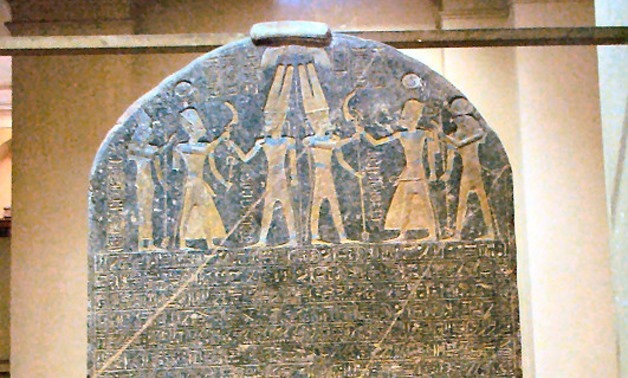
Seti Merenptah’s 'Israel' Stele


Merneptah Stele - Webscribe, Wikimedia Commons

by
 
Damien F. Mackey


Bimson thought (at least as late as 1980) that Merenptah’s Stele had pre-dated
the fall of Samaria by about a decade, to c. 734-733 BC; it being a reference rather
to the earlier Assyrian deportations of Israel by Tiglath-pileser III.


To recall what I have written previously:
 
– According to Courville, as we have seen, the stele’s inscription pertains to the Assyrian deportation of Samaria in c. 722/721 BC.
 
– Velikovsky would later look to connect it with the deportation of the Jews to Babylon after the sack of Jerusalem by Nebuchednezzar II [Ramses II and His Time, pp. 189-196]. Though Bimson has estimated Velikovsky’s date for the 5th Year of Merenptah at “no earlier than 564 BC … 23 years after the fall of Jerusalem” [‘An Eighth Century Date for Merenptah’, p. 57].
 
– Bimson thought (at least as late as 1980) that Merenptah’s Stele had pre-dated the fall of Samaria by about a decade, to c. 734-733 BC; it being a reference rather to the earlier Assyrian deportations of Israel by Tiglath-pileser III. …. [Ibid. See also ‘John Bimson replies on the “Israel Stele”,’ pp. 59-61].
 
– Rohl has in turn dated the conquests described in the stele to those effected by Seti I and Ramses II, his candidate for the biblical ‘Shishak’, himself regarding the stele as being Merenptah’s merely basking in the glory of what these, his great predecessors, had achieved before him. […. A Test of Time, ch. 7, pp. 164-171].
 
[End of quote]
 
For Drs. Velikovsky, Courville and Bimson (back then), this Egyptian Stele was supposedly commemorating one or another Assyro-Babylonian triumph – a most unlikely scenario! 
 
And Rohl, for his part, though regarding the document as being a commemoration of Egyptian victories, considered these to be triumphs pre-dating pharaoh Merenptah – victories by his predecessors, Seti I and Ramses II.  
 
Only Martin Sieff, amongst the revisionists, had envisaged this as being an Egyptian victory achieved by Merenptah himself.
 
Thus I wrote:
 
– And Sieff … related Merenptah’s victory to what he called the “time of troubles in the northern kingdom of Israel after the death of Jeroboam II”.
 
Martin Sieff’s realistic version, which is the one that I basically embraced in my postgraduate university thesis (Volume One, Chapter 11, pp. 300-305):
 
A Revised History of the Era of King Hezekiah of Judah
and its Background
 
 
was dependent upon the biblical chronology of Martin Anstey - and taken up by Philip Mauro - that the reign of Jeroboam II in Israel was followed by a 22-year period of interregnum.
 
Patrick Clarke
 
Rohl’s revised chronology, according to which Ramses II was the biblical pharaoh “Shishak” at the time of king Rehoboam of Judah (I Kings 14:25), has recently been picked up by Creationist, Patrick Clarke in his article, “The Stele of Merneptah—assessment of the final ‘Israel’ strophe and its implications for chronology”:
 
 It is clear that the Merneptah stele can be interpreted in line with the United and Divided Monarchy Periods of Israelite history. Furthermore, if it can be demonstrated that Merneptah’s father, Ramesses II, was in fact Shishak, many synchronisms previously held by both supporters of the CEC [conventional] and revisionists between the people of Israel and their neighbours collapse, and a whole new series of compelling synchronisms emerges. The reigns of Ramesses II and Merneptah are contemporaneous with the last few years of the United Monarchy and the first 75 years of the Divided Monarchy. A detailed analysis of the ‘Israel’ text indicates that far from being placed in the 1200s bc, Merneptah’s reign should be dated to 913–903 bc; a movement of three centuries. Consequently, Ramesses II would have reigned from 979–913 bc, in the Divided Monarchy Period. In my proposed revised chronology all the political, military, and economic factors detailed on the stele coincide with conditions in Israel. This was not the case three centuries earlier in the time of the Judges.
[End of quote]
 
Whilst Clarke is correct in rejecting the conventional location of the Merenptah Stele to the approximate period of “the Judges”, his chronological re-setting of Ramses II and Merenptah has, in my opinion, dire consequences for the best efforts of the revision as explored by the likes of Drs. Velikovsky and Courville, and modified and enhanced by astute minds of the “Glasgow School” (including Martin Sieff).
For, as Clarke goes on to write:
 
Once this historical re-alignment takes place, a number of synchronisms previously held to be true by some revisionists, albeit well-intentioned, are refuted. Some of these erroneous synchronisms are: Thutmose III/Shishak;31 Hatshepsut/Queen of Sheba;32 Amenhotep II/Zerah the Cushite; Israel’s King Ahab/Battle of Qarqar; Israel’s King Jehu/Shalmaneser III—the final two failed synchronisms in this list have serious implications for the less than reliable Assyrian chronology.33
[End of quote]
 
No thank you. I myself shall stick with the, now manifold, synchronisms - as worked out by revisionists - between Egypt’s 18th dynasty and the United to Early Divided kingdom periods, especially those iron-cast synchronisms with El Amarna.
 
Clarke’s most useful contribution is, in my opinion, his expertise in Egyptian Hieroglyphics, which he has correctly noted has not been a strong suit amongst revisionists: “Knowledge of the Egyptian language and syllabic orthography is essential when assessing any Egyptian text, otherwise mistakes are inevitable”. Thus Clarke writes with regard to the Stele: 
 
This reliance in Christian works on blind copying of old, outdated translations, which probably reflects the dearth of competent archeology and history specialists in the Christian community, is fraught with problems, as will be seen.
 
Knowledge of the Egyptian language and syllabic orthography is essential when assessing any Egyptian text, otherwise mistakes are inevitable. The majority of Egyptologists are in agreement regarding the entity ysry3l as Israel based on the syllabic orthography of the name and the context of the final poetic unit of the Merneptah stele. It is the chronological placement of Israel where scholars of the CEC and revisionist positions come into conflict.
[End of quote]
 
Clarke is particularly scathing about professor Joseph Davidovits, whom he calls “A secularist”, regarding the latter’s unorthodox translation of the Victory Stele (see Clarke’s section on p. 62: “A secularist attempt to deny Israel is even mentioned on the stele”).
 
A suggested solution
 
With my modification of the Nineteenth Egyptian Dynasty in its relation to Seti and the awkward Third Intermediate Period in multi-part series such as:
 
Smendes and Shoshenq I
 
beginning with:
 
 
and:
 
Seti I and Seti II Merenptah
 
beginning with:
 
 
I am now inclined to accept Rohl’s and Clarke’s opinion that the Israel Stele pertains to an early Nineteenth Dynasty ruler, such as Seti – but with my twist to this, that Seti was Merenptah.
 
See especially my article on this:
 
Seti I and Seti II Merenptah. Part Three: Seti I and II Merenptah and Merenptah