Wednesday, June 25, 2014

Why Moses and Joshua were told by Yaweh to remove their sandals


“Whose Sandal Strap I am Not Worthy to Untie”


The book by the prominent Spanish scripture scholar Luis Alonso-Schokel called I Nomi Dell'Amore (The Names of Love) provides a fascinating and spiritually rich look at marriage symbols in the bible. I’d like to offer a brief summary of some of the insights of the chapter from that book entitled "The Levirate."


Schokel begins by noticing 5 similar texts from the New Testament all dealing with St. John the Baptist:


Matthew 3:11 he who is coming after me is mightier than I, whose sandals I am not worthy to carry


Mark 1:7 After me comes he who is mightier than I, the thong of whose sandals I am not worthy to stoop down and untie


Luke 3:16 he who is mightier than I is coming, the thong of whose sandals I am not worthy to untie; he will baptize you with the Holy Spirit and with fire.


John 1:27 even he who comes after me, the thong of whose sandal I am not worthy to untie.


Acts 13:25 after me one is coming, the sandals of whose feet I am not worthy to untie.


Now any text repeated in all of the gospels (and the book of Acts too) must have a grand significance. Most people will see it as illustrating the humility of the Baptist, unworthy to untie the sandals of the Lord, but several internal hints point to a deeper, more profound answer.


Schokel points out three textual clues:


1) In John 1:30 the Baptist speaks of Christ as, "This is he of whom I said, `After me comes a man who ranks before me, for he was before me.'" The word translated as "man" here is not the Greek word "anthropos" usually translated as man, instead it is "aner" a word, as Schokel points out, having more of a "sexual" (in the sense of gender) or relational meaning. It isn't man, but "male" (maschio in Italian); a male in relation to a female. The passage would better be translated in English, "After me comes a male who ranks before me." [John the Baptist is the "anthropos" - see John 1:6, 3:27]. Schokel also points out the references in John 1-3 to Isaiah 40-66, esp. chapter 54:1-10, where Yahweh is referred to as the Bridegroom/husband and in the LXX, the "aner")


2) At least in the synoptics the word "unworthy" or "unfit" has a juridical sense. That word is "ikanos" while John uses "axios." So it seems to be more of unfitness according to some type of Judaic law, and with the use of "aner" possibly a marital law.


3) Looking a few chapters down, we come to the last words of John recorded in the gospel. In responding to questions as to who this Jesus is, he responds, "You yourselves bear me witness, that I said, I am not the Christ, but I have been sent before him. He who has the bride is the bridegroom; the friend of the bridegroom, who stands and hears him, rejoices greatly at the bridegroom's voice; therefore this joy of mine is now full" (John 3:28-29). John here is challenging Israel's Messianic expectations - they expect their Christ to come as a political leader, or a warrior, or even a prophet like John the Baptist, but John says this is incorrect. He says that the messiah will come as the Bridegroom of his bride Israel; ultimately that Israel has the wrong expectations.


So keeping all of this in mind: the repeated reference to untying of sandals, the "maleness" of Christ, the juridical context, and the spousal-messianism John uses to describe the Christ, Schokel (along with the Fathers) exegetes this text in light of the Levirate Law in the Old Testament.


The Levirate Law (derived from Latin levir, meaning "a husband's brother") is the name of an ancient custom ordained by Moses, by which, when an Israelite died without issue, his surviving brother was required to marry the widow, so as to continue his brother's family through the son that might be born of that marriage (Gen 38:8; De 25:5-10 ) comp. (Ruth 3:1 4:10) Its object was "to raise up seed to the departed brother." But if the surviving brother refused (for whatever reason) to marry the widow, a rite called "Halizah" would occur. Deut 25:5-10 describes the Levirate and Halizah:


"If brothers dwell together, and one of them dies and has no offspring, the wife of the dead shall not be married outside the family to a stranger; her husband's brother shall go in to her, and take her as his wife, and perform the duty of a husband's brother to her.


And the first son whom she bears shall succeed to the name of his brother who is dead, that his name may not be blotted out of Israel. And if the man does not wish to take his brother's wife, then his brother's wife shall go up to the gate to the elders, and say, `My husband's brother refuses to perpetuate his brother's name in Israel; he will not perform the duty of a husband's brother to me.' Then the elders of his city shall call him, and speak to him: and if he persists, saying, `I do not wish to take her,' then his brother's wife shall go up to him in the presence of the elders, and pull his sandal off his foot, and spit in his face; and she shall answer and say, `So shall it be done to the man who does not build up his brother's house.' And the name of his house shall be called in Israel, The house of him that had his sandal pulled off" (Deuteronomy 25:5-10).


The sandal is the key - the sandal is symbolic of he who has the right to marriage. The one who wears the sandal is the Bridegroom. As St. Cyprian said, this is why both Moses (Ex 3:2-6) and Joshua (John 5:13-15) were told by Yaweh that they had to remove their sandals; although they might have been prophets, they were not the one who had the right to marry Israel the Bride. In saying that he is not fit (juridically) to remove the sandal from Jesus' foot he is saying that Jesus is the bridegroom, he is the one who has the right to marriage, not John - even though he came first.


"Even though he came first" - John admits to this, being the precursor of the Messiah-Bridegroom, but he is not the one that will marry the bride (as he is not the Messiah, as some of the Jews had thought). To understand this better (and the entire Levirate process) one must look to the book of Ruth. In it, the widow Ruth is set to marry her "next of kin" via the levirate law, but Boaz arrived first to claim Ruth, It does not matter though, the next of kin has first choice. But he decides to pass up the marriage to Ruth, and gives her to Boaz. And in doing so he "drew off his sandal" (Ruth 4:8). Even though John came first, Jesus is the one with the right to the woman, and he opts for the marriage - and thus does not remove his sandal. John will not be given the chance to take his place.


This interpretation of these passages are not new, as Schokel points out. Several of the Fathers, including Jerome, Cyprian, and Gregory all see the Levirate law being referred to in the passages about John the Baptist. As Jerome writes, "being as that Christ is the Bridegroom, John the Baptist is not merited to untie the laces of the bridegroom's sandal, in order that, according to the law of Moses (as seen with Ruth) his house will not be called "the house of the un-sandaled," [a reference to the refusal to carry on the name of the deceased brother].


So, if John is not the messiah-bridegroom, and is unfit to untie the bridegroom's sandals, as the "friend of the groom" - what is his duty, esp. in the Levirate context? The root of his mission "to prepare the way of the Lord" can be found in Ruth 3:3 when the elders tell Ruth before her wedding to "Wash therefore and anoint yourself, and put on your best clothes." John's baptism of repentance is done to prepare the bride for the wedding.


Liturgically, he cleans her from her impurities (see also Ezekiel 16) preparing the bride "that he might sanctify her, having cleansed her by the washing of water with the word" (Ephesians 5:26). To prepare Israel the Bride for her nuptial with Christ her bridegroom is the heart of the Baptist's mission.


Now with all symbolism and typologies, it is hard to "stretch" the analogy too far. But in order to get the full meaning of Christ's fulfillment of the Old Testament, one has to twist symbols around a bit. In order to do understand one other crucial aspect of the Levirate, that of the "deceased" brother, we must be a bit creative, and look at it from a different perspective. Christ marries his bride, consummates his union with her, on the cross (see Eph 5) - but this leads to his death. So he could be seen as the "dead husband." So who will be the "brother" who takes his place in marrying his bride? For the answer we must again turn to the gospel of John.


"When Jesus saw his mother, and the disciple whom he loved standing near, he said to his mother, 'Woman, behold, your son!' Then he said to the disciple, 'Behold, your mother!' And from that hour the disciple took her to his own home" (John 19:26-27).


Jesus had no other brothers, so he gave his mother to John - and thus in becoming her son, John (and all apostles and Christians likewise) became Jesus' brother. But we cannot forget that on a different level (see Rev 12) Mary is the "icon of the church," the bride - so John as he becomes Jesus' brother, is given to the Church as her bridegroom. Here we have what Schokel says might be seen as the "root of apostolic succession." The Church is passed on from brother/apostle to brother/apostle - yet the bride still keeps the name of her first husband, as Paul writes, "Is Christ divided? Was Paul crucified for you? Or were you baptized in the name of Paul?" (1 Corinthians 1:13). The name of the husband is carried on by the generation of new sons, thus the brother through his preaching of the word, causes the bride to become fruitful. Look to St. Paul (a Jew well versed in the Law) again, "For though you have countless guides in Christ, you do not have many fathers.


For I became your father in Christ Jesus through the gospel" (1 Corinthians 4:15). The bishops/apostles have their charge to carry on the name of Christ by preaching the gospel and celebrating the sacraments - and in doing so the church/bride becomes church/mother and the Levirate law is thus fulfilled in Jesus Christ.


....

Taken from: http://ourladyofwisdom.org/wp-content/uploads/2011/12/levirate.pdf

Thursday, June 19, 2014

War used as a means to worship Golden Idol of Money: Pope Francis


Pope declares war exists because economies ‘sacrifice man at the feet of the idol of money’

By Catholic Online (NEWS CONSORTIUM)
6/13/2014 (6 days ago)
Catholic Online (www.catholic.org)
In interview, Pope says he's unconcerned about security because he doesn't have much to lose
....
Pope Francis in a newspaper interview said that the world's economy is fueled by war, as the world's biggest nations "sacrifice man at the feet of the idol of money," to "obviously keep their balance sheets in the black." The pontiff was searing in his criticism about the callousness of world governments. He also livened the interview with a touch of wit. When asked if he had any security concerns, Pope Francis replied, "at my age I don't have much to lose."
....


Highlights
By Catholic Online (NEWS CONSORTIUM)
Catholic Online (www.catholic.org)
6/13/2014 (6 days ago)
Published in Living Faith
Keywords: Pope Francis, interview, war, economies, Pope Pius


LOS ANGELES, CA (Catholic Online) - The interview was published this week in the Spanish-language daily newspaper La Vanguardia.

"We are in a world economic system that is not good," Pope Francis said. "A system that in order to survive must make war, as great empires have always done. But since you cannot have a Third World War, you have regional wars. And what does this mean? That arms are made and sold, and in this way the idolatrous economies, the great world economies that sacrifice man at the feet of the idol of money, obviously keep their balance sheets in the black."

Come shop out beautiful collection of rosaries by going here --

Pope Francis also reiterated one of his signature themes, that globalization's failings are not only material but cultural, since it "cancels differences." The pontiff called for an economic system that preserves each person's "particularity, richness, identity."

The Pope also addressed violence and killing done in the name of religion, citing the 17th-century Thirty Years' War.

Christianity, Judaism and Islam all "have our fundamentalist groups, small in relation to the rest", he said. "A fundamentalist group, even if it doesn't strike anyone, is violent. The mentality of fundamentalism is violence in the name of God."

The interview was conducted that day after Pope Francis presided over an "invocation for peace" at the Vatican with Israeli President Shimon Peres and Palestinian President Mahmoud Abbas. The Pope said that event took place in spite of skepticism from his own subordinates.

"It was not easy," the Pope said. "Here in the Vatican, 99 percent said it would not happen and afterward the one per cent grew."

The Pope also defended the record of his predecessor Pope Pius XII. He said that opening Vatican archives relating to the Holocaust "will shed much light" on that subject. Pope Pius, critics maintain did not say or do all he could to oppose the Nazi genocide.

"They have dumped everything on poor Pius XII. But you have to remember that once he was seen as the great defender of the Jews," he said. "I am not saying that Pius XII did not make mistakes - I myself make a lot - but you have to interpret his role in the context of the time. Was it better, for example, that he not speak in order to avoid the killing of more Jews, or that he speak?"
---

Pope Francis: end world hunger through 'Prayer and Action'


© 2014 - Distributed by THE NEWS CONSORTIUM

Pope Francis Prayer Intentions for June 2014
Unemployed:
That the unemployed may receive support and find the work they need to live in dignity.
Faith in Europe: That Europe may rediscover its Christian roots through the witness of believers.

....

Friday, May 23, 2014

The Surprising Truth About How the Great Pyramids Were Built


Sheila Berninger and Dorilona Rose   |   May 18, 2007

05:42am ET 


This Behind the Scenes article was provided to LiveScience in partnership with the National Science Foundation.
"This is not my day job," begins Michel Barsoum as he recounts his foray into the mysteries of the Great Pyramids of Egypt. As a well respected researcher in the field of ceramics, Barsoum never expected his career to take him down a path of history, archaeology, and "political" science, with materials research mixed in.

Tuesday, April 22, 2014

Ancient Evidence of the Exodus from Egypt


Some historians set the time of the Exodus story around the time of Ramses II (1303 BCE-1213 BCE). The Tanakh claims that the Israelis built Ramses, while an inscription from around the time of Ramses II states “Distribute grain rations to the soldiers and to the Apiru who transport stones to the great pylon of Ramses.” Similarly, a victory stele of Pharaoh Amenhotep II (1427 BCE-1401 BCE), lists various captives sent to Egypt and 3600 Apiru are listed as Egyptian slaves, implying that Apiru slaves were already in the Land of Egypt in the time of Ramses II. Some scholars believe the Apiru to be Hebrews.

Pharaoh's DaughterHowever, ancient Egyptian records assert that nothing resembling the Exodus story took place during the time of Ramses II. This fact has led some to question the existence of the Exodus story. Yet, Immanuel Velikovsky, writing in 1952, has asserted that the apparent conflict between archeology and the Tanakh related to the Exodus story is based on the fact that the Exodus story has been misdated and that if the Exodus story is dated correctly, all such contradictions disappear. Furthermore, the archeologist Emmanuel Anati asserted, “The name of Ramses, in the book of Exodus and in that of Genesis, emerges as a geographical indication: it indicates the site where, according to tradition, the Hebrews were in Egypt. It is not necessarily the same name that the site must have had at the epoch of the Patriarchs or at the time of Moses.”

Parting of Red SeaIndeed, according to the Midrash, the Pharoah of the Exodus story was named Adikam, not Ramses II, and he had a short reign of four years before drowning in the Red Sea. The Pharaoh who preceded Adikam, according to the Midrash, was named Malul, who reigned from age six to 100. Interestingly, the Egyptian historian priest, Manetho, writing in the 3rd century BCE, as well as an ancient Egyptian papyrus known as the Turin Royal Cannon mentioned a pharaoh who ruled from age six to 100 known as Pepi II (2284 BCE-2184 BCE).
Interestingly, during the Sixth Dynasty, of which Pepi II was part, the Egyptians conducted many punitive raids. According to Anati, “A commander by the name of Uni immortalised the actions against the Asiatics “that live in the territory of sand” and describes situations comparable to those in the book of Exodus. From the accounts we get a picture of a world conceptually and contextually very near that described in the biblical narrations. The army of Uni devastated the animal enclosures, destroyed the huts, chopped down the figs and grape trees and safely came back to Egypt.”

ipuwer papyrusFurthermore, the Ipuwer Ammunitions, dated between 2345 BCE to 2181 BCE, describes many events very similar to the Ten Plagues. One papyrus notes “the river is blood,” which corresponds with Exodus 7:20, stating “all of the waters that were in the river turned to blood. Another papyrus claimed “the land is not light,” which is similar to Exodus 10:22, “and there was a thick darkness in all of the land of Egypt.” Yet still another papyrus spoke of “forsooth, gates, columns, and walls” being “consumed by fire,” while Exodus 9:23-24 asserted, “The fire ran along the ground….there was hail and fire mingled with hail, very grievous.”

And another papyrus spoke of how the trees were “destroyed. No fruits nor herbs were found.” Exodus 9:25 claimed, “And the hail smote every herb of the field and brake every tree of the field.” Furthermore, even the killing of the First Born Sons was mentioned in this Papyrus, claiming, “Forsooth, the children of princes are dashed against the wall. Forsooth, the children of princes are cast into the streets.” Exodus 12:29 declared, “And it came to pass, at midnight, the Lord smote all of the firstborn in the Land of Egypt, from the firstborn of Pharoah that sat on the throne unto the firstborn of the captive that sat in the dungeon.” Although the matter is still hotly debated, given this evidence, the Exodus story could likely have taken place earlier than what many archaeologists assert.

By Rachel Avraham

....

Taken from: http://unitedwithisrael.org/archeological-parrallels-for-the-exodus-story/


Tuesday, April 15, 2014

The Documentary Hypothesis does Damage to the Bible


This series came in seven installments: an Intro, then Parts 1, 2, 3, 4, 5, and 6. Because I am preaching through Genesis it seems fair to introduce the Old Testament documentary hypothesis (sometimes called the JEDP theory), its relationship to Genesis studies, and my reasons for rejecting it.
Instead of working from scratch it is expedient to construct the next few blogs around the book, Before Abraham Was: A Provocative Challenge to the Documentary Hypothesis by Kikawada (Berkeley) and Quinn (Princeton). Their book is borrowed scaffolding. Along the way I will show where my perspective varies from theirs, but my main objective is to explore the documentary hypothesis and reasons for my rejection of it.

An Admission
I am not trying to be fair to all adherents of the documentary hypothesis. That is, I necessarily will work with main thrusts coming from the theory, even as I know that nuances abound and updated versions have new tweaks, twists and turns. I maintain, however, that updates and tweaks to a sunken ship won’t free it from its watery grave, restore its crew, and get it sailing. I am no more persuaded by the latest apologetics of Jehovah Witnesses or Islam than I am with the next defense from the documentary hypothesizers.
A Definition
The documentary hypothesis of the Pentateuch (the first five books of the Old Testament) states that there is a long history and complex layering of story fragments that comprise Genesis. The Darwinian view of the Grand Canyon is illustrative of the hypothesis. As with the Canyon, one looks upon stratum and supposedly gets irrefutable evidence for long evolutionary periods. The writings of Moses are his in name only, for really they are accretions — the production of so many editors over so many centuries. Each contributor laid down their particular layer until, over time, the Pentateuch finally reached a settled state. This is a hypothesis grown in the same dark and moldy room as Darwinian evolution. It too is rooted in the 1800s as it is, “a characteristic product of its time…” (9).
According to the program of the documentary hypothesizers, Genesis 1-11 is not read as the unveiling of one mind — not Moses’s, let alone God’s — but is a particolored quilt of seams and patches that betray the tinkerings of Jewish scribes. These editors secretly and anonymously created a poorly done religious history that shows no higher design than propagandized agendas. As man evolved from apes, so the books of Moses are not by special design; they are manuscripts that suffer the accidents of time. They emerged as survivors of religious fitness and scribal mutations.
They have a presently stable form despite their tumultuous struggle to emerge from the scribal slime. According to the clever inspectional work of specially trained researchers from the 19th century, that scribal slime turns out to be composed of at least four detectable editors. We don’t know who the editors are, of course, but we can assign them names. The most common monikers for the four are J, E, P and D. That is, the J editor (along with her disciples and followers) is uniquely discernible behind particular patches in the variegated quilt. Of course, discerning J is not a black and white venture because the specially trained researches are not uniform in their imaginations.
A Problem
Just as Darwin’s evolution is pre-Micro Biology, pre-Computer, pre-Flight, pre-Hubble, pre-NASA, pre-GNOME, pre-Einstein, pre-Nuclear, … so the documentary hypothesis is a leftover from an age long gone. The documentary hypothesis was a mistake of history never meant to upstage the real sciences of Archaeology, Egyptology, Assyriology and Linguistics. Biblical studies can be likened to other sciences. As the physical sciences frequently abandon false starts, Biblical studies are not beholden to failed conjectures advanced during the pre-archaeological period.
Before Abraham Was. Chapter 1
Genesis 1-11 tells the story of creation, Adam, the fall, Noah, the flood, the tower of Babel and the emergence of nations. The pre-flood period is as its own world with its own history. Out of the ark emerged a new history distinct from Genesis 1-5. And in terms of God’s redemptive activity, all of it is a prelude to Abraham (who shows up in Genesis 12). “Before Abraham Was” refers to the long and complex history of Genesis 1-11.
The Name (הַשֵּׁם)
In the telling of Judah’s long and complex history, God’s name is alternatively “Elohim”, “Yahweh” and sometimes “Yahweh Elohim”. Switches between these names are taken to be the DNA evidence of different editors. According to the documentary hypothesis, Genesis 1-5 is internally grouped according to two editorial schools — one written by priests who use “Elohim” and one from the editors who use “Yahweh.” To this day Yahweh is not a name often spoken by Jews. At some point in the Jewish past (perhaps after the destruction of the temple in AD 70), the name Yahweh ceased to be pronounced by the religiously pious. It is a priestly concern that guards the name as holy.
The Sources: J, E, P, D
J, E, P and D are names given to the theoretical schools who wrote that which Moses wished he wrote (Genesis, Exodus, Leviticus, Numbers and Deuteronomy). In fact, the only thing that documentary scholars seem to agree about is that Moses and his helpers were too dense to pull off the complex writing that recorded God’s activities. In fact, when they get done with their hypothetical scholarship, Moses himself probably did not exist, the exodus is a myth, and the only thing that is certain is that they are scholars of what they consider to be a fairytale book. Following this pattern, in 2000 years I expect people to get their PhDs in Harry Potter and then to endlessly debate and pretend that their ideas merit the attention of other scholars.
P stands for Priestly and designates the supposed editor who reworked material according to a late priest’s perspective. An orthodox priest of Jerusalem (writing after the Babylonians took Jerusalem) sees God as above, wholly other, far off, creating by his words, inhabiting his high mountain, instituting Sabbath, and dwelling in a heavenly and exalted temple. The P editors used Elohim as the name of the deity (being too humble to evoke the covenant name). Thus the P material of Genesis can be detected in the use of the name Elohim, particularly when God is acting or speaking with priest-like concerns (holiness, sacrifices, otherness, exalted status, etc.).
J is for Jehovah. The Hebrew name Yahweh was rendered by Germans scholars (leaders in the development of the documentary hypothesis) as Jehovah. I use Yahweh and Jehovah interchangeably. The documentary hypothesis postulates that Yahweh/Jehovah would have connoted the view of a conservative religious editor writing from a Jerusalem-like perspective. Namely, Yahweh is the name of the God who was with Israel in the wilderness. Yahweh is the God who walked in the garden of Eden. He is the relational God with a revealed covenantal name. The conservative religious editor is from the southern kingdom of Judah and employed the name Jehovah as a polemical way to obtain distance from the polytheistic religions.
E is the name of the non-Priestly editor who used “Elohim” to reference God. Elohim is plural. This plural form is interpreted as a residual of a polytheistic editor. It represents a theological point of view — a view that would have been at home in the northern kingdom of Israel (Ephraim). Roughly speaking, E designates editors from Ephraim who were less critical of polytheism and who used the name Elohim to reference God (II Kings 1:3).
One can see how the documentary hypothesis is capable of putting a lot of stock in a name. The selection of a name to alternately encode a polytheistic or monotheistic worldview is to laden one word with the essence of a religious debate. Of course it is possible that the plural ending is a theological polemic revealing the polytheistic DNA of northern editors, but if we go by an argument from possibilities, then it is just possible that it is not the case. In fact, by Occam’s razor, the documentary hypothesis asks one word to do too much.
JEP Naming the different editors and authors, the books of “Moses” can be graphically sliced and color coded according to the different contributors.
However, the documentary hypothesis is sophisticated enough that it won’t be boiled-down to name usage only. One can observe that with each switch in name (Elohim vs. Yahweh), there is a corresponding switch in literary style. Genesis 1, for example, has a different feel than Genesis 2. Genesis 1 uses Elohim and Genesis 2 uses Yahweh. One style is Priestly (P), another is Yahwehistic (J).
So what we find in Genesis 1-5 are not only changes in vocabulary, narrative styles, and theologies, but also unnecessary…repetitions–and all these obey the general sectioning of Genesis 1-5 suggested by the divine names. (20).
Inventors of the Documentary Hypothesis have Invented a Crisis
The astute reader detects stylistic changes as Genesis unfolds; chapter 1 gives way to chapter 2, and things move around and the story has development and action as we go from 2 to 3 all the way to the end of the book. At this point the documentary hypothesis invents a crisis by finding contradictions whenever the camera angle changes or when a new character comes in uninvited. After the crisis is elevated to the level of a force-ten hurricane, the hypothetical scholar puts on his cape and the documentary hero emerges to save us from the dreadful deluge.
The documentary hypothesis had its own Noah, and his name was Wellhausen (21).
Without a single story teller, we are quickly saved from the notion of a single theme. The story of the Bible can’t be about Jesus (who named himself as the theme in John 5:39), but is about something altogether different. The Bible becomes the story of hypothesizing scholars. It becomes the story of how 19th century scholarship untangled the mess of ancient Hebrew texts.
Scholars of the Documentary Hypothesis are Self Created Heroes
The creation story ceases to be how the Holy Spirit brooded over the formless void to create order. Genesis becomes a formless mass of texts where vipers find their brood wherein to hatch hypothetical scholars. The documentary scholars have come to save us from the despair of an ancient story that moves along and has development. They save us by saying there is no theme and there is no single author. They relieve us of seeing how God and Moses wrote the Pentateuch. The hypothetical scholar becomes the hypothetical savior to save us from thinking that God wrote a book. God is dethroned, and the scholar is put in his place.
Our salvation comes in realizing that we have been tricked. There is no unified author and only the discovery of editors shows the order embedded in the formless crisis. They created the problem, and they created the solution, and they are the real heroes of the story. The Bible, it turns out, is about them and their scholarship.
The Documentary Hypothesizers are Blind to Masterminds and Artists
The documentary hypothesizers don’t know about single authors who write complex, changing and multi-faceted masterpieces. A single book, like Genesis, with a single author… it is preposterous! Who could imagine such a thing? Moses writing Genesis 1 and Genesis 2 would be like a musician who could play two instruments. Vocalists can sing only one song. Artists can make only one album. Narrators can’t write poetry, and poets can’t write history, and historians can’t make music. Moses couldn’t write Genesis, because that would mean he was able to write both Genesis 1 and Genesis 2 (and that insanity would be a crisis of Biblical proportion). It is too complex. Genesis was created over centuries and each editor attributed his part according to his editorial-kind. And so the crisis is solved. Salvation has come and we are relieved from believing that one author could have written an amazing book.
If Genesis 1-5 is the product of a single author, then that author is capable of two quite different narrative styles and no compunction about using them…from this thesis and antithesis we would expect him to attempt a synthesis, a synthesis that would exhibit to an even greater degree his theological profundity and literary virtuosity (21).
How to Answer a Fool
Kikawada and Quinn are sharp, almost sarcastic, in how they represent the documentary hypothesis — perhaps following the Proverb, “answer a fool according to his folly.” If a fool thinks that the many colors of a great painting prove that the painting had many artists and many pallets, then what is left to say? Great artists do paint great paintings. Genius authors do write complex books. God did create the visible and invisible realms and all that is in them — writing down his deeds seems like a lesser feat. The answer for the fool is too obvious to give, so sarcasm may be all that is left for them.
God is the Author of the Bible
In the beginning, God created the heavens and the earth. His story has a beginning and an end, and Jesus is the Alpha and Omega. The story is history that radiates from a point and consummates in a Lamb. God has worked and created according to a unified purpose; the Holy Spirit hovered over the formless void to bring it into conformity to the pattern of the architect. The same God who did this promised by his Spirit that he would attend to the keeping of the divine records. Earth would contain a written copy of the heavenly records (John 14:26), and it does. We have the Bible. It is a book divine in origin. This is no more incredible than a God who can create the whole cosmos. Whoever invented atoms, molecules, air, water, cells, blood, frogs, trees, dirt, elephants, you, volcanoes, quarks, planets, space, and light can have a book. In the grand scheme of things, to believe that God wrote a book is not a crisis.
The documentary hypothesis is a rival theology that presumes to talk about God. It refuses to have him as he is revealed. Like the first rebel force, it starts by asking, “Has God really said” (Gen 3:1), and then goes on to articulate how God is not the Alpha and Omega. God becomes like us, only less so, for he is nothing more than the invention of an editor or a theologian from the 1800s. Documentary hypothesizers are unable to see a single author, and so the question of a single theme is not even a possibility for them. When we can’t find a single author for the Bible, it becomes a collection of circumstantially gathered writings bound together from evolutionary processes. If God can’t keep a record, then he can’t give us his grand theme or purpose. The documentary hypothesis is nothing more than another way of saying Amen to the crafty serpent of the garden.

Steve Rives
Eastside Church of the Cross

....

Taken from: http://mrrives.com/Gezer/?p=187

Friday, April 11, 2014

No archaeological evidence to support Ramses II as Pharaoh of Exodus: Ron Beeri


Rare sarcophagus, Egyptian scarab found in Israel

Associated Press
Content preferences                    
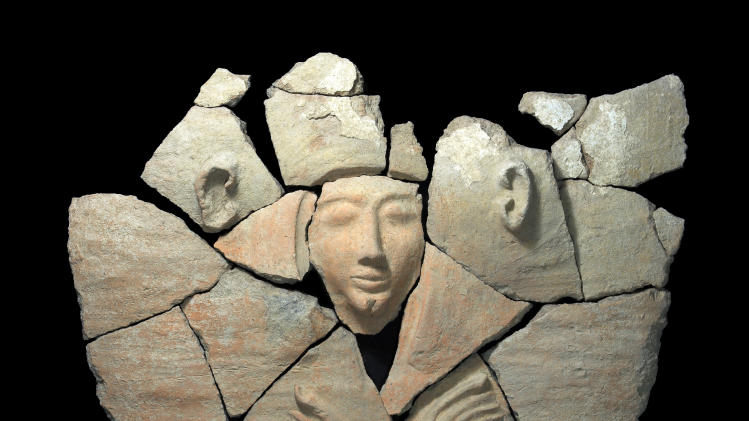
This undated photo released by Israel’s Antiquities Authority shows a sarcophagus found at Tel Shadud, an archaeological mound in the Jezreel Valley. Israeli archaeologists have unearthed a rare sarcophagus featuring a slender face and a scarab ring inscribed with the name of an Egyptian pharaoh, Israel’s Antiquities Authority said Wednesday April 9, 2014. (AP Photo/ Israel’s Antiquities Authority)
.
View gallery


  • .

. ....

JERUSALEM (AP) — Israeli archaeologists have unearthed a rare sarcophagus featuring a slender face and a scarab ring inscribed with the name of an Egyptian pharaoh, Israel's Antiquities Authority said Wednesday.
The mystery man whose skeleton was found inside the sarcophagus was most likely a local Canaanite official in the service of ancient Egypt, Israeli archaeologists believe, shining a light on a period when pharaohs governed the region.
"This is a really beautiful face, very serene," said Edwin van den Brink, an Egyptologist and archaeologist with Israel's government antiquities authority. "It's very appealing."
Van den Brink said archaeologists dug at Tel Shadud, an archaeological mound in the Jezreel Valley, from December until last month. The archaeologists first uncovered the foot of the sarcophagus and took about three weeks to work their way up the coffin. Only on one of the excavation's last days did they brush away the dirt to uncover the carved face.
The lid of the clay sarcophagus is shattered, but the sculpted face remains nearly intact. It features graceful eyebrows, almond-shaped eyes, a long nose and plump lips. Ears are separated from the face, and long-fingered hands are depicted as if the dead man's arms were crossed atop his chest, in a typical Egyptian burial pose.
Experts last found such a sarcophagus about a half a century ago in Deir al Balah in the Gaza Strip, where some 50 similar coffins were dug up, mostly by grave robbers, van den Brink said. Some of them greet visitors today at the entrance to the archaeology wing at the Israel Museum in Jerusalem. Dozens were previously found in Beit Shean in Israel's north.


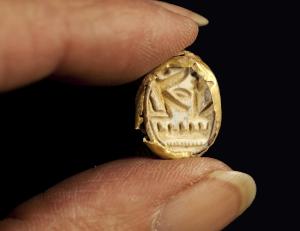
Found alongside the new sarcophagus was a scarab seal ring encased in gold, carved with the name of Pharaoh Seti I, who ruled ancient Egypt in the 13th century BC. Seti I conquered the area of today's Israel in the first year of his reign, in order to secure Egyptian trade routes and collect taxes for Egypt, said archaeologist Ron Beeri, who participated in the dig. The man buried in the sarcophagus might have been a tax collector for the pharaoh, Beeri said.
Seti I was the father of Ramses II, often identified as the pharaoh in the biblical story of the Israelite exodus, though Beeri said there is no historical evidence to support that.
DNA tests may be conducted to determine if the man in the sarcophagus was Canaanite or Egyptian, Beeri said.
The recent archaeological discovery, like most in Israel, came by happenstance. Israel's natural gas company called in archaeologists to survey the territory before laying down a pipeline. Van den Brink said the Antiquities Authority excavated only a small, 5-by-5 meter (16-by-16 foot) area, but that was enough to find the sarcophagus, the scarab and four other human remains.
Van den Brink said the site likely was a large cemetery, with other sarcophagi likely waiting to be found in future digs.
"It's just a small window that we opened," he said.


....