To the reader who is trying to convince me that the Exodus was in Arabia
(and who also believes that Moses was in Mecca, and that Abraham was in Arabia):
“Although the Bible has Abraham going to
Mitzraim which is generally accepted as being Egypt (until we started to
uncover our clues) the Koran has Ibrahim visiting Arabia”:
Did you
take your lead from Islam? Or Islamic scholars?
Some of
them have Cheops' architect, Hemiunu, as the Haman of the Book of Esther.
Not a bad
try, only about a millennium out.
Their Prophet
is strangely connected in various cases with non-existent (at the time)
Nineveh.
Ahmed
Osman has managed to fit all the main biblical characters, from Abraham to
the Holy Family, into just the one 18th Egyptian dynasty.
You,
yourself, have Abraham in Arabia.
Dr. John Osgood has identified
archaeologically, in Late Chalcolithic, the destruction in Palestine (note)
caused by Amraphel of Shinar and his coalitional mates (Genesis 14).
“... genetic researchers connected the source population of ancient Crete
to the well-known Neolitihic sites in Anatolia ...”.
Gavin Menzies and Ian Hudson
Gavin Menzies and Ian Hudson, in The Lost Empire of Atlantis: History's Greatest Mystery Revealed, introduce us to professor Constantinos Triantafyllidis of Thessaloniki’s Aristotle University and his important DNA studies of the Cretan so-called ‘Minoans’ (ch. 7):
Now that scientists are ableto test genetic theories with rigour, I was here because of the new study reported by The Times. New work by an international groupof geneticists showed that a section of Crete's Neolithic population (i.e. pre-Bronze Age) did indeed go there by seafrom Anatolia – modern-day Turkey. Professor Constantinos Triantafyllidis of Thessaloniki’s Aristotle University had published the findings of a research group led by geneticists from Greece, the United States, Canada, Russia and Turkey.Professor Triantafyllidis states that their analysis indicated that the arrival of these new people on Crete had coincided witha social and cultural upsurge that had led to the birthof the Minoan civilisation around 7000 BC. Specifically, genetic researchers connected the source population of ancient Crete to the well-known Neolitihic sites in Anatolia:
The earliest Neolithic sites of Europe are located in Crete and mainland Greece. A debate persists concerning whether these farmersoriginated in neighbouring Anatolia and over the role of maritime colonisation.To address171 samples were collected from areas near three known early Neolithic settlement areas in Greece together with 193 samples from Crete. An analysis of Y-chromosome hectographs determined that the samples from the Greek sites showed strong affinity to Balkan data, while Crete shows affinity with central/ Mediterranean Anatolia.Haplogroup J2b–M12 was frequent in Thessaly and Greek Macedonia while haplogroup J2a–M410 was scarce. Alternatively, Crete, like Anatolia showed a high frequency of J2a-M410 and a low frequency of J2b-M12. This dichotomy parallels archaeobotanical evidence, specifically that white bread wheat (Triticum aestivum) is knownfrom Neolithic Anatolia, Crete and southern Italy; [yet] it is absent from earliest Neolithic Greece ....
[End of quote]
From a biblical point of view, I think, the estimated date for “the birthof the Minoan civilisation around 7000 BC” would be very roughly 5000 years too early.
But the origin of the Neolithic ‘Minoans’ in Anatolia would be perfectly in order, considering that post-Flood man must have spread out from ancient Urartu (Kurdistan), eastern Anatolia:
Starting with the breaking DNA news, and this rather sinks the ‘Black Athena’ theory from Bernal…
....
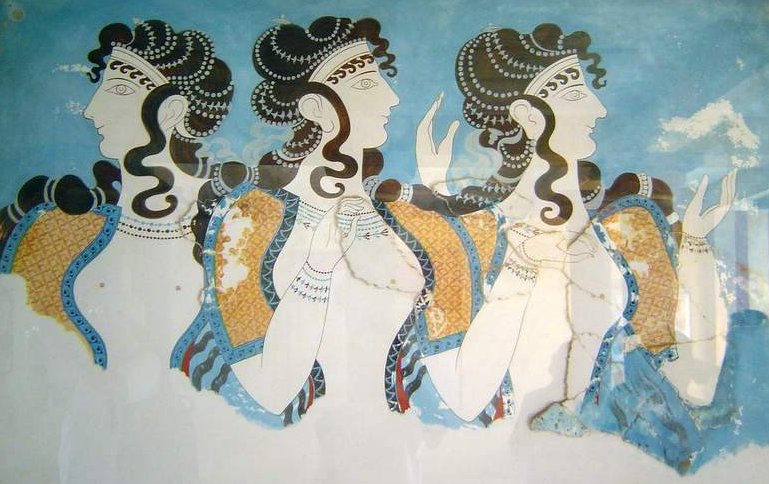
Crete’s fabled Minoan civilization was built by people from Anatolia, according to a new study by Greek and foreign scientists that disputes an earlier theory that said the Minoans’ forefathers had come from Africa.
The new study – a collaboration by experts in Greece, the USA, Canada, Russia and Turkey – drew its conclusions from the DNA analysis of 193 men from Crete and another 171 from former neolithic colonies in central and northern Greece.
The results show that the country’s neolithic population came to Greece by sea from Anatolia – modern-day Iran, Iraq and Syria – and not from Africa as maintained by US scholar Martin Bernal.
The DNA analysis indicates that the arrival of neolithic man in Greece from Anatolia coincided with the social and cultural upsurge that led to the birth of the Minoan civilization, Constantinos Triantafyllidis of Thessaloniki’s Aristotle University told Kathimerini.
“Until now we only had the archaeological evidence – now we have genetic data too and we can date the DNA,” he said.
Archeological dates for the colonisation of Crete are about 7,000 BC.
In more detail
The most frequent haplogroups among the current population on Crete were: R1b3-M269 (17%), G2-P15 (11%), J2a1-DYS413 (9.0%), and J2a1h-M319 (9.0%). They identified J2a parent haplogroup J2a-M410 (Crete: 25.9%) with the first ancient residents of Crete during the Neolithic (8500 BCE – 4300 BCE) suggesting Crete was founded by a Neolithic population expansion from ancient Turkey/Anatolia. Specifically, the researchers connected the source population of ancient Crete to well known Neolithic sites of ancient Anatolia: Asıklı Höyük, Çatalhöyük, Hacılar, Mersin/Yumuktepe, and Tarsus. Haplogroup J2b-M12 (Crete: 3.1%; Greece: 5.9%) was associated with Neolithic Greece. Haplogroups J2a1h-M319 (8.8%) and J2a1b1-M92 (2.6%) were associated with the Minoan culture linked to a late Neolithic/ Early Bronze Age migration to Crete ca. 3100 BCE from North-Western/Western Anatolia and Syro-Palestine (ancient Canaan, Levant, and pre-Akkadian Anatolia); Aegean prehistorians link the date 3100 BCE to the origins of the Minoan culture on Crete. Haplogroup E3b1a2-V13 (Crete: 6.7%; Greece: 28%) was suggested to reflect a migration to Crete from the mainland Greece Mycenaean population during the late Bronze Age (1600 BCE – 1100 BCE). Haplogroup J1 was also reported to be found in both Crete and Greece (Crete: 8.3%; Greece: 5.2%), as well as haplogroups E3b3, I1, I2, I2a, I21b, K2, L, and R1a1. No ancient DNA was included in this study of YDNA from the Mediterranean region. ....
Now, turning to geographical considerations, “eastward” and “plain of Shinar”, there may be
a pressing need to shift the conventional goal posts. And that is exactly what Anne Habermehl has done in her ground-breaking article, “Where in the World Is the Tower of Babel?”
Language of Babel
This heading is not so much concerned about the language, or languages, spoken at ancient Babel, as about a re-consideration of the meaning of the words/phrases particularly of verse 1: “whole world”; “eastward”; “plain of Shinar”.
Here, as in the Pentecost event of Acts 2, translations might superficially convey the impression of a global event, “whole world” (Genesis 11:1), to be compared with Acts 2:5’s “every nation under heaven”. A pairing of Babel with Pentecost is relevant insofar as the disastrous confusion of languages in the case of the former, owing to the sin of pride (Genesis 11:4, 7-9), is Divinely undone by the miraculous phenomenon of “tongues” at Pentecost (Acts 7:11): “… we hear them declaring the wonders of God in our own tongues!”
With the benefit of such a comparison it may be suggested that the confusion of languages was, just as was the Flood, only “local in geographic extent” (for full quote, read on further).
The different and contemporaneous Sumerian and Akkadian languages may have been a result.
Matt Lynch, however, has a somewhat different take on Babel and Pentecost (2016):
Once, when I was teaching a church class, two people started speaking to each other in German. It made things easier for them because it was their native language. But it didn’t make things easier for Margaret (name changed). With deep frustration she exclaimed, ‘Can we just speak English here!’
The experience of linguistic diversity leads many to wish for unity—or rather, homogeneity. Wouldn’t it be nice if everyone just spoke normal (i.e., English)? That desire for intelligibility is understandable, but the desire for that language to be English can also betray ethnocentrism. Especially from where I come in the U.S., which has no national language, the fight to retain English can easily slide into a fear-driven attempt to keep ‘our’ culture and ‘our’ language dominant.
Confusion over Babel
Yesterday the church celebrated its founding linguistic event—Pentecost—an event that many hail as the definitive reversal of Babel. Whereas at Babel, God confused languages, at Pentecost, God brought people of all languages together and united them. At Babel tongues were confused. At Pentecost, tongues were understood. You get the idea.
However, Pentecost may not be anti-Babel in the way some suppose. For starters, the reversal idea assumes that a unified language was a good idea gone wrong, and that eschatological unity would somehow involve a return to one language—a Spirit language.
But Genesis never states that the confusion of languages was a bad thing. The only downside was for the Babelites, who couldn’t finish their Manhattan project. On the positive side, language diversification enabled humanity to get on with the task of ‘filling the earth,’ something they were meant to do but didn’t because of their big hero project. Notice the language in Gen 11:4:
Come, let us build ourselves a city, and a tower with its top in the heavens, and let us make a name for ourselves; otherwise we shall be scattered abroad upon the face of the whole earth.
God had wanted humans to ‘fill the earth’ (Gen 1). Babel was in direct contravention of God’s intended vision of teeming diversity.
At Pentecost, God embraces language diversity. He doesn’t destroy it. So yes, the Spirit reverses the imperial unification of Babylon, but not the multiplication of languages.
Empires and Language
To see why the preservation of multiplication is important, it’s important to grasp the imperial function of language unification. Joel Green helps us here:
The wickedness of this idolatrous plan [to build Babel] is betrayed in the opening of the Babel story, with its reference to ‘one language’—a metaphor in the ancient Near East for the subjugation and assimilation of conquered peoples by a dominant nation. Linguistic domination is a potent weapon in the imperial arsenal, as people of Luke’s world themselves would have known, living as they did in the wake of the conquest of ‘the world’ by Alexander the Great and the subsequent creation of a single, Greek-speaking linguistic community.[1]
By confusing languages God was merciful, not punitive. He already recognized that ‘this is only the beginning of what they will do’ (11:6). Who knows what WMDs the Babelites would’ve created? Middleton writes, ‘Babel thus represents a regressive human attempt to guarantee security by settling in one place and constructing a monolithic empire, with a single language, thus resisting God’s original intent for humanity.’[2]
So God gave humanity a push toward its original purpose, to fill the world, cultivate it, build cultures, and grow. Linguistic diversity is a natural outgrowth of this process, and one which the Spirit rubber stamps at Pentecost.
Israel& the Nations
But before we land on Pentecost, it’s important to look at a few snapshots of Israel’s ‘universal’ vision in Isaiah:
In days to come the mountain of the LORD’s house shall be established as the highest of the mountains, and shall be raised above the hills; all the nations shall stream to it. … For out of Zion shall go forth instruction, and the word of the LORD from Jerusalem. (Isa 2:2-3)
I am coming to gather all nations and tongues; and they shall come and shall see my glory… And I will also take some of them as priests and as Levites, says the LORD. … From new moon to new moon, and from Sabbath to Sabbath, all flesh shall come to worship before me, says the LORD. (Isa 66:18, 21, 23)
In the first vision, the nations come to receive instruction from Israel. In the second, they come to worship, and some even becomes priests. They come as nations, with all their diversity of languages (‘nations and tongues’). And, they retain their identity as nations. They neither dissolve into one gigantic Israelite world empire nor isolate themselves completely.
Israel’s worship system includes foreigners and receives the nations’ offerings, while the nations receive teaching from Israel.
Pentecost—Preservation and Unification
When we turn to Pentecost, we see that the Spirit is similarly uninterested in unifying language: ‘Jews … from every nation under heaven … each one heard them speaking in the native language of each’ (Acts 2:5-6).
Things were getting out of hand, so Peter stood up to interpret the event. He did so by drawing on Joel 2, which anticipated a work of the Spirit that obliterated a different sort of division. Here’s Peter quoting from Joel 2:28-29:
In the last days, God says, I will pour out my Spirit on all people. Your sons and daughters will prophesy, your young men will see visions, your old men will dream dreams. Even on my servants, both men and women, I will pour out my Spirit in those days, and they will prophesy. (Acts 2:17-18)
The point couldn’t be clearer—the Spirit gave without regard for status, sex, or nationality. In giving, the Spirit unified the people of God (‘tearing down the dividing wall of hostility’ Eph 2:14), but in a way that preserved their cultural diversity.One Spirit, many gifts. One Spirit, many languages. The Spirit doesn’t negate difference, but cultivates and leverages that difference in service of God’s mission toward all nations.
So yes, Pentecost reverses the homogeneity of Babel. And yes, Pentecost reverses any hostility that may have arisen in the wake of linguistic confusion. Yet, the Spirit puts the diversity of cultures (preserved in their languages) on display and empowers each for the proclamation of a de-centered Good News. This was a profoundly anti-imperial move. The point isn’t that the Spirit speaks one language. Instead, the Spirit speaks your language—no matter who you are. ....
Returning now to the subject of geographical extent, for the Flood, for Babel, Rich Deem has written of “The Genesis Flood Why the Bible Says It Must be Local”:
“Psalm 104 directly eliminates any possibility of the flood being global (see Psalm 104-9 - Does it refer to the Original Creation or the Flood?). In order to accept a global flood, you must reject Psalm 104 and the inerrancy of the Bible. If you like to solve mysteries on your own, you might want to read the flood account first and find the biblical basis for a local flood.
The Bible's other creation passages eliminate the possibility of a global flood
The concept of a global Genesis flood can be easily eliminated from a plain reading of Psalm 104,1 which is known as the "creation psalm." …. The verse that eliminates a global flood follows: "You set a boundary they [the waters] cannot cross; never again will they cover the earth." (Psalm 104:9)1 Obviously, if the waters never again covered the earth, then the flood must have been local. Psalm 104 is just one of several creation passages that indicate that God prevented the seas from covering the entire earth.2 An integration of all flood and creation passages clearly indicates that the Genesis flood was local in geographic extent”.
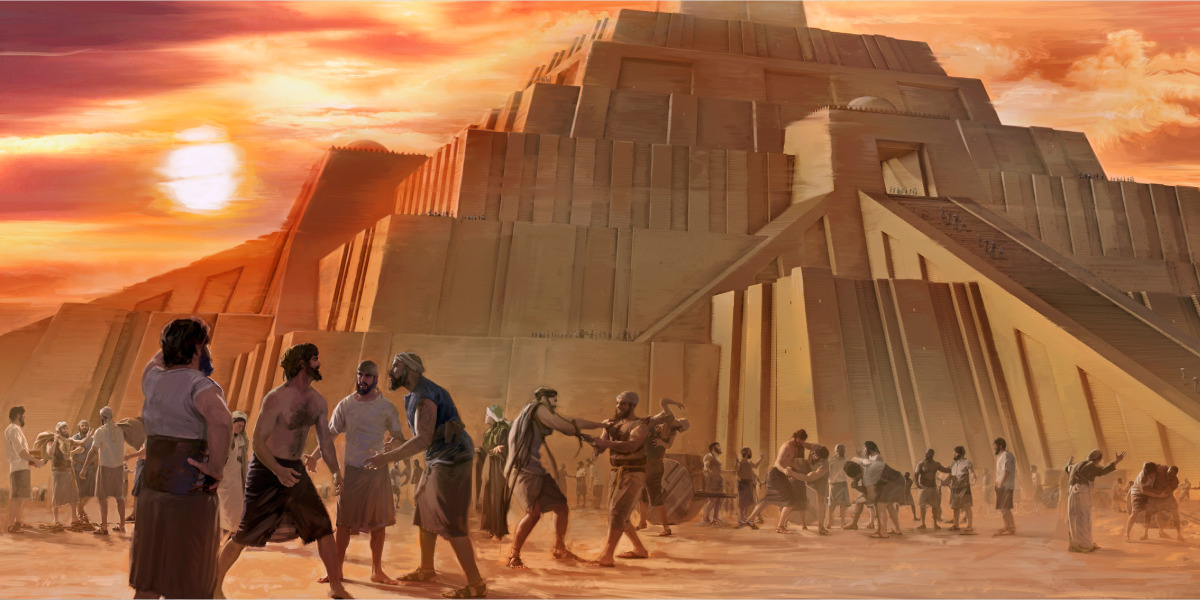
Now, turning to geographico-linguistic considerations re Babel, “eastward” and “plain of Shinar”, there may be a pressing need to shift the conventional goal posts. And that is exactly what Anne Habermehl has done in her ground-breaking article, “Where in the World Is the Tower of Babel?” (https://answersingenesis.org/tower-of-babel/where-in-the-world-is-the-tower-of-babel/), there shifting the geographical focus for the Tower of Babel incident away from southern Iraq (ancient “Sumer”), the customary “Cradle of Civilisation”, to the Khabur region of NE Syria. According to this new view, the biblical “land of Shinar” to whose “plain” men migrated after the Flood (Genesis 11:2), and thought to indicate “Sumer”, is roughly to be identified, instead, as the region of Sinjar (the scene of much fighting in our era).
This is how Anne Habermehl has introduced (summarised) her article:
Abstract
The biblical story of the Tower of Babel is believed by many to be the record of a real historical event that took place after the worldwide Flood, at a time when the earth’s population still lived together in one place. The enduring archaeological question, therefore, is where the Tower of Babel was built. It is widely considered that Shinar, where the Bible says the Babel event took place, was a territory in south Mesopotamia; and that Babel was located at Babylon. However, an analysis of history, geography, and geology, shows that Shinar cannot have been in the south, but rather was a territory in what is northeastern Syria today; and that the remnants of the Tower must be located in the Upper Khabur River triangle, not far from Tell Brak, which is the missing city of Akkad.
An immediate point in Habermehl’s favour is that she has been able to, in her scholarly and well-researched article, provide a fairly compelling identification (namely, Tell Brak) for the lost city of Akkad (Accad), Nimrod’s city (Genesis 10:10), so famous in ancient times, but not identified even to this day.
Akkad is generally estimated to have been situated in the environs of modern Baghdad.
As to the word, “eastward”, one may have to ask, “eastward” from where?
Various translations of the word, the Hebrew miqqedem (מִקֶּדֶם), are “from the east”, “in the east”. The Ark survivors were last heard of “on the mountains of Ararat [Urartu]”, which is already close to the eastern extremities of the ancient world. It is unlikely that preserved humanity travelled even further “eastwards” (or its variants) than this in search of fertile habitable land.
Hebrew miqqedem also has the meaning “of old [long ago”], which makes more sense to me.
Further, regarding the location of the Tower of Babel, the Septuagint (LXX) Isaiah provides a geographical clue which, whilst conforming with Habermehl’s location of biblical “Shinar”, would not, however, support a conventional location of the land as Sumer, nor anywhere further “eastward”. In Ellicott's Commentary for English Readers we read this intriguing information, regarding Isaiah 10:9: “Is not Calno [Calneh] as Carchemish? is not Hamath as Arpad? is not Samaria as Damascus?” (“... instead of naming Carchemish, gives “Calanè, where the tower [ὁ πύργος] was built ...”):
“…. Is not Calno as Carchemish?—The six names obviously pointed to more recent conquests in which Sargon and his predecessors had exulted. One after another they had fallen. Could Judah hope to escape? (1) Calno, the Calneh of Genesis 10:10, Amos 6:2. That prophet had held up its fate in vain as a warning to Samaria. …. The LXX. version, which instead of naming Carchemish, gives “Calanè, where the tower [ὁ πύργος] was built,” seems to imply a tradition identifying that city with the Tower of Babel of Genesis 11:4. (2) Carchemish. Few cities of the ancient world occupied a more prominent position than this. Its name has been explained as meaning the Tower of Chemosh, and so bears witness to the widespread cultus of the deity whom we meet with in Biblical history as the “abomination of the Moabites” (1 Kings 11:7)”.
Some have even associated the god Chemosh with Ham himself, the son of Noah.
This switches the land of the Tower of Babel away from Sumer to the vicinity of Carchemish.
The name, Carchemish, including apparently the meaning of “Tower”, may indicate that this is where the attempted building of the Tower of Babel had been undertaken.
It could not have been in the well-known Babylon of Sumer, which city was begun much later.
Any map of Mesopotamia will show that - whether one believes Noah’s Ark to have landed on Mt. Çudi (Judi) in Kurdistan, or Mt. Ararat in Turkey - ancient Babylon is hundreds of kilometers directly south of both of these places. Various authors have pointed this out. “This somewhat inconvenient geographical fact (for those who believe that the people migrated eastward or westward) is downplayed by those who believe that the Tower was built at the city of Babylon, and requires inventing scenarios that move the people far enough south while still satisfying their perception of this Scripture”. (Anne Habermehl’s article)
Sadly, the location of other cities connected with Nimrod in this same Genesis verse (10:10): “The beginning of [Nimrod’s] kingdom was Babel and Erech and Accad and Calneh, in the land of Shinar”, is also a matter of dispute. Some translations even get rid of “Calneh” altogether, by substituting “all of these [i.e., Babel, Erech and Accad] in the land of Shinar”.
Another point in Habermehl’s favour, I think, is that her choice of Sinjar (Shinjar) for “Shinar” is far more linguistically plausible than is “Sumer”.
Scholars and historians have been totally confounded by the abrupt rise of the Sumerian culture nearly 6,000 years ago in the Fertile Crescent of the Tigris and Euphrates Rivers. This “sudden civilisation” seemed to appear out of thin air and refused to conform to the popular historical theory of linear development in cultural evolution.
Historian Professor Charles Hapgood squarely faces the issue when he writes that “today we find primitive cultures co-existing with advanced modern society on all continents… We shall now assume that 20,000 years ago while paleolithic peoples held out in Europe, more advanced cultures existed elsewhere on earth.”
Likewise the rise of Sumeria has been a major puzzle.
Joseph Campbell in The Masks of God writes, “With stunning abruptness… there appears in this little Sumerian mud garden… the whole cultural syndrome that has since constituted the germinal unit of all high civilisations of the world.”
William Irwin Thompson puts it even more succinctly. “Sumer is a poor stoneless place for a neolithic culture to evolve from a peasant community into a full-blown civilisation,” he writes, “but it is a very good place to turn the plains and marshes into irrigated farmlands … In short, Sumer is an ideal place to locate a culture already having the technology necessary for urban life and irrigation agriculture.”
This would indicate that human settlement of Sumer, and the cities and culture that developed from this, had occurred somewhat later than was formerly believed.
There is to be considered the possibility that pre-Flood Cain-ites had settled there and that, after the Flood, when Sumer was re-settled, Cain-ite names were re-applied to the cities that now sprang up there. My earlier view had been, in line with others, that cities named after the Cain-ites (Enoch, Irad, Tubal-cain) were identifiable in the names of southern Mesopotamia cities. According to: http://xenohistorian.wordpress.com/2008/03/31/the-babylonian-connection-
David Rohl has proposed that both Uruk and Ur were named after Enoch, because their actual Sumerian names were Unuk and Unuki, respectively. Rohl goes on to see a connection between Bad-tibira and Tubal-Cain, because Bad-tibira means “City of the Metal Worker.” Finally, Eridu, which archaeologists and Sumerian historians believe is the oldest city of all, could have been named after Irad (according to Rohl) or Jared (according to Zecharia Sitchin).
Cain himself, though, as traditions seem to indicate, settled on the edge of “Seth’s land”. According to what we learned earlier, Cain had not moved far from the vicinity of the Garden of Eden.
As already touched upon, NE Syria is also more geographically proximate (than is Sumer) for the descendants of Noah from my point of view (Habermehl is obviously a global Floodist), according to which Noah’s Ark landed upon the mountains of modern Kurdistan (ancient Urartu). It might be expected, then, that humankind would soon find its way into the fertile Khabur region. That this region qualifies as a “plain” is apparent from Habermehl’s description of it (she includes a photograph):
“It is difficult to tell from what we know of history exactly where the boundaries of the entire land of Shinar were; indeed, those boundaries may not even have remained precisely the same at different times. However, we will generally describe Shinar as a land including the territory that is located immediately south of the Turkish mountains between the Tigris and Euphrates rivers. This area is almost perfectly flat as far as the eye can see (fig. 2). It surely qualifies as “a plain in the land of Shinar,” as Genesis calls it”.
There is yet another most useful upside to Habermehl’s reconstruction; one that she herself has pointed out, and it is not favourable to the documentary theory: “One result of “moving” Babel from south Mesopotamia to the north of Syria is that secular historians will no longer be able to claim that the building of the Tower was merely a story inspired by the ziggurat at Babylon (for example, Parrot 1955, p. 17)”.
In fact, with the early Genesis scene shifted right away from Babylonia, then those old arguments according to which the Book of Genesis (e.g., the Flood) had borrowed from Mesopotamian lore will no longer carry any force.
It is well known where the ancient city of Babylon stood. But - and as Habermehl strongly - argues, Babylon and the “Babel” of Genesis 10:10 are not necessarily synonymous.
Habermehl herself does not actually identify the location of Babel. She presumes that it must lie at the approximate centre of the triangle of cities that she has associated with Genesis 10:10.
But might not the LXX be telling us, by substituting the name “Babylon” for “Carchemish”, that the impressive site of Carchemish (modern Jerablus) was itself a Babylon, a Babel? – perhaps in close association with Calneh – in the very region “where the Tower was built”?
One unusual French scholar, Fernand Crombette, whose unique and complicated method of translating ancient texts with the aid of Coptic has bemused many, had claimed that Carchemish was where Noah and his sons lived after the Flood, and that its modern name, Jerablus, actually translates as The Naked Man (L‘homme nu), referring to the incident of the drunken Noah (Genesis 9:20-25). Given that the region of Carchemish may have been the suitable place for grape vines: “In Mesopotamia, grapevines could be nurtured only in the north, notably in the region of Carchemish” (P. King, Life in Biblical Israel, p. 98), then Crombette may have got this right. Northern Syria might have been, for this very reason, the first place of choice for migrations after the Flood waters had begun to subside.
That does not necessitate, however, that all human groups, post-Flood, had converged upon the fertile “plain in the land of Shinar”.
Carchemish, once excavated by the famed adventurer, T. E. Lawrence (“Lawrence of Arabia”), but now currently situated on the boundaries of a war zone, awaits a fuller archaeological effort. “Nicolò Marchetti of Bologna University, who leads the renewed investigations with a joint Italian-Turkish team beginning in 2011, says that, despite the city's historical significance, only 5 percent of the site has been excavated”.
I personally should be most interested to find whether further excavational work at the site of Jerablus (Carchemish), or its environs, might yield any evidence of the famous Tower of Babel.